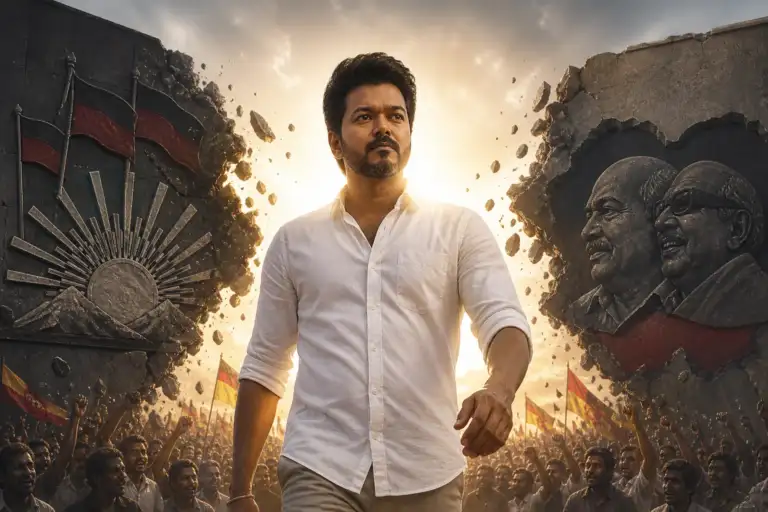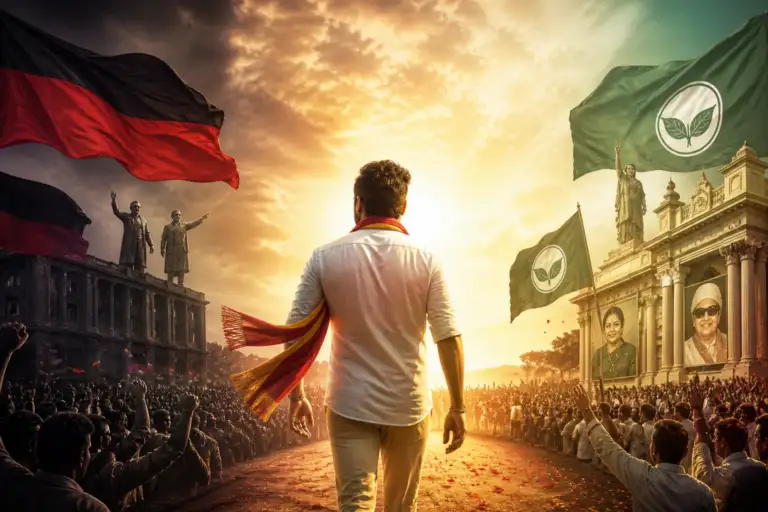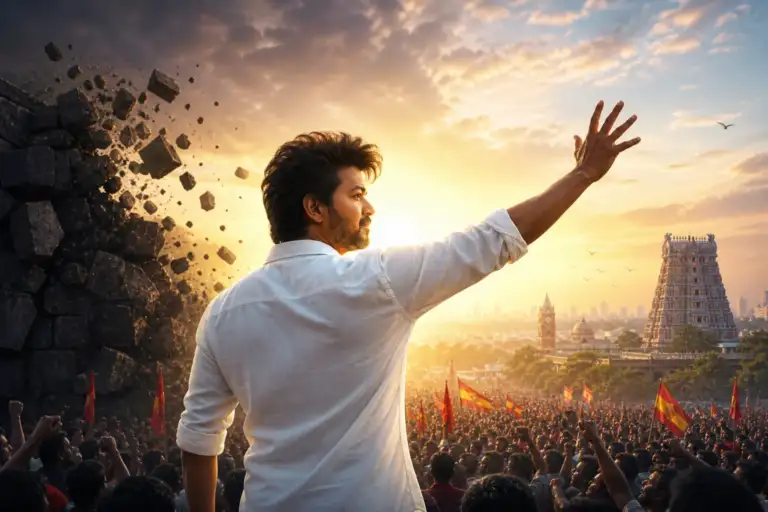
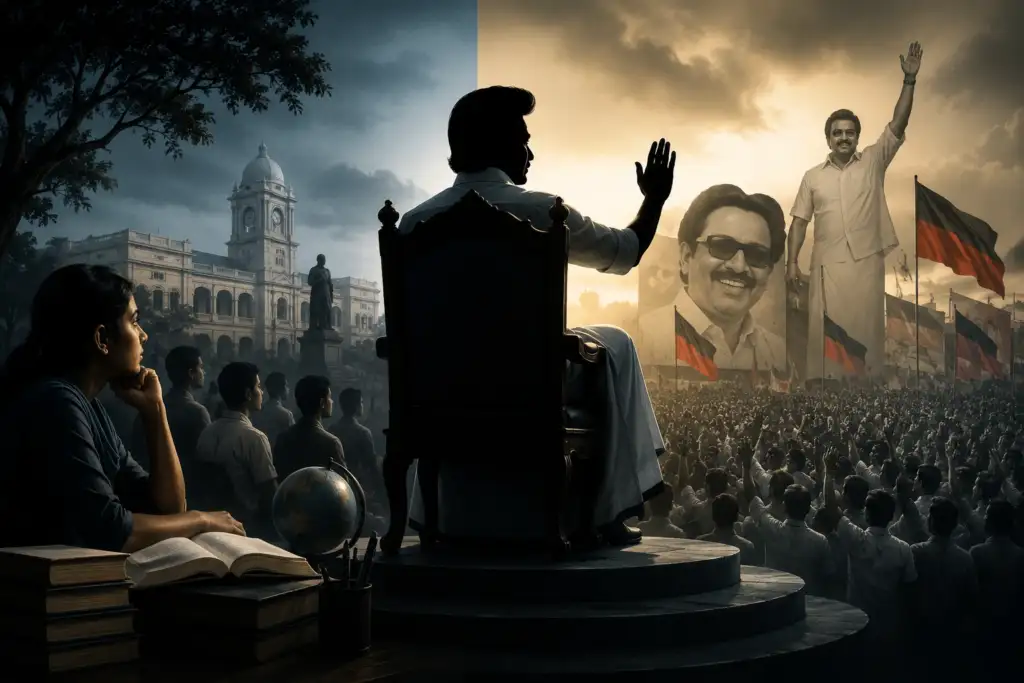
Tamil Nadu is one of India’s most politically aware states.
Or at least, that’s what we like to believe.
This is a state that debates ideology like cricket scores. People question dynasty politics, criticize corruption, reject caste equations, analyze religion in politics, mock money power, and constantly demand accountability from governments.
And honestly, that political awareness is a strength.
Democracy becomes healthier when voters question power.
But then comes the contradiction that makes absolutely no sense.
If Tamil Nadu has evolved politically so much, why does cinema still overpower qualification?
Why does stardom still carry political weight in one of India’s most educated states?
That is the real puzzle.
Not Vijay alone.
Not one election.
Not one political party.
The larger question is about society itself.
Because Tamil Nadu seems politically rational in every area except one:
Celebrity worship.
Vijay’s rise is not the issue. What it represents is.
Let’s be clear.
This is not an attack on Vijay.
He has every democratic right to enter politics.
Just like anyone else.
But the uncomfortable question is this:
Why does being an actor still instantly create political legitimacy in Tamil Nadu?
That emotional logic becomes harder to explain in 2026.
Because today’s Tamil Nadu is not struggling with illiteracy or lack of awareness like previous generations did.
This is a state filled with:
- First-generation graduates
- Engineers
- Doctors
- Government employees
- UPSC aspirants
- Entrepreneurs
- Highly skilled professionals
- Academically brilliant students
People spend years earning qualifications, clearing competitive exams, surviving brutal educational pressure, and building expertise.
Society constantly tells ordinary people:
Earn your place.
But in politics, the rules suddenly become emotional.
A man spends decades:
- Acting
- Dancing
- Delivering punch dialogues
- Building fan clubs
- Becoming famous
And then political power somehow becomes the “next natural step.”
Why?
That question deserves honest discussion.
Tamil Nadu questions dynasty politics… but not stardom
This is what makes the contradiction fascinating.
Tamil Nadu voters today openly reject:
- Dynasty politics
- Corruption
- Religious extremism
- Caste equations
- Vote-bank politics
- Money power
Even deeply rooted political structures are no longer guaranteed loyalty.
That shows political maturity.
But then how does cinematic aura still survive as political capital?
If dynasty politics is criticized because leadership should not be inherited emotionally, then how is celebrity worship different?
Why should screen presence create public trust automatically?
Why does fan culture become political credibility?
The emotional logic completely collapses there.
MGR made sense in a different era. But what is today’s excuse?
This conversation becomes uncomfortable because Tamil Nadu’s cinema-politics relationship has historical roots.
MGR emerged during a period where:
- Literacy rates were lower
- Cinema was the most powerful communication medium
- Welfare politics was still evolving
- Accessibility mattered more than policy literacy
For that generation, cinema heroes symbolized aspiration and accessibility.
That context mattered.
But this is not the 1970s anymore.
Today:
- Education is widespread
- Internet access is everywhere
- Political information is instantly available
- People are far more socially aware
So naturally, the next question becomes unavoidable:
Why does an educated society still emotionally depend on actors for political hope?
Instagram politics is replacing real politics
The rise of Vijay and TVK also revealed something bigger about modern Tamil Nadu politics.
Politics is increasingly being consumed through:
- Reels
- Fan edits
- Viral speeches
- Emotional montages
- Meme wars
- Background music edits
- Algorithm-driven hype
Young voters are beginning to experience politics emotionally before understanding it structurally.
That is dangerous.
Because governance is not cinematic storytelling.
Real life does not function like movie intervals.
Roads do not improve through mass intro scenes.
Unemployment cannot be solved through charisma.
Healthcare, infrastructure, administration, education, and economic policy require competence, negotiation, and governance depth.
Not screen presence.
“If politicians fail, actors will step in.” But why is that even the default thought?
During the election period, actor Vishal made a statement at a polling booth interview saying:
“If politicians fail, actors will step in.”
And honestly, that single sentence perfectly captures Tamil Nadu’s political contradiction.
Because think about what that statement unintentionally reveals.
How did society arrive at a point where the natural alternative to failed politicians automatically became actors?
Why not:
- Economists?
- Administrators?
- Educators?
- Retired judges?
- Social reformers?
- Civil servants?
- Grassroots leaders?
- Policy experts?
- Young professionals?
- Qualified ordinary citizens?
Why is cinema still positioned as the emotional backup generator for governance?
That is the real question.
Because the statement itself is not the issue.
The mindset behind why it sounds normal is.
Somewhere deep within Tamil Nadu’s political culture, society has subconsciously accepted the idea that fame creates leadership potential.
And that is a dangerous democratic habit.
A state filled with educated youth, first-generation graduates, highly qualified professionals, and politically aware citizens should never instinctively believe that the only replacement for failed politicians is another celebrity.
That logic would only make sense in a society that still emotionally depends on hero worship.
And maybe that is exactly the uncomfortable truth Tamil Nadu still refuses to confront.
The common man is not inferior to an actor
This is the saddest part of all.
Tamil Nadu’s obsession with celebrity politics quietly reinforces one dangerous idea:
Fame matters more than qualification.
But why?
How is the first-generation graduate less capable?
How is the government employee who cleared impossible exams less worthy?
How is a teacher, doctor, engineer, social worker, or entrepreneur somehow politically inferior to a celebrity whose influence exists because audiences spent ₹200 on movie tickets?
Actors are not gods.
They are professionals performing a craft.
That deserves respect.
But it should not automatically create political superiority.
And maybe Tamil Nadu’s youth need to realize something important:
They are not beneath the people they worship.
Tamil Nadu already has better political examples
The irony is that Tamil Nadu’s own history already proves leadership does not need cinematic worship.
Kamarajar built respect through governance and educational reform.
Annadurai built influence through ideology, communication, and political thought.
Their legitimacy came from public work.
Not box office collections.
Not fan clubs.
Not mass hero worship.
Somewhere over time, emotional familiarity started overpowering political evaluation.
And perhaps that is where political awareness slowly became political emotionalism.
This is not anti-actor. It is pro-self-respect.
Actors absolutely belong in democracy.
Anyone can enter politics.
That is not the issue.
The issue is society treating stardom itself as a qualification.
Because an educated democracy should never behave as though leadership can only emerge from fame, cinema, and celebrity culture.
The state belongs equally to:
- The student studying under pressure
- The government employee serving the system
- The professional solving real-world problems
- The ordinary citizen who understands ground realities better than scripted narratives
Tamil Nadu should not emotionally depend on stardom to feel hopeful.
Here’s My Take
Thalapathy Vijay’s political rise to become the chief minister is not just a political event.
It is a mirror.
A mirror reflecting how deeply Tamil Nadu still confuses cinematic influence with leadership potential.
And maybe that is the most uncomfortable truth of all.
Because a state that proudly questions dynasty, caste, religion, corruption, and money power somehow still struggles to detach leadership from fame.
Which raises the question nobody wants to answer honestly:
Has Tamil Nadu become politically illiterate when it comes to celebrity worship?
Because if an educated society still believes charisma is more convincing than qualification, then perhaps the problem is not lack of education.
Perhaps it is emotional dependency disguised as political choice.
And maybe the saddest realization is this: