Introduction: A Political Earthquake Nobody Predicted
There are moments in politics when everything you thought you knew gets tossed aside. The 2026 Tamil Nadu assembly election was one of those moments.
When Joseph Vijay, better known across India simply as Thalapathy, walked off film sets and into the political arena in February 2024, the reactions ranged from curiosity to outright dismissal. Critics called it a vanity project. Political veterans said he lacked the structural depth to challenge parties that had ruled the state for decades. Even supporters quietly worried that an actor’s charm might not translate into ballot-box reality.
On May 4, 2026, all of that changed.
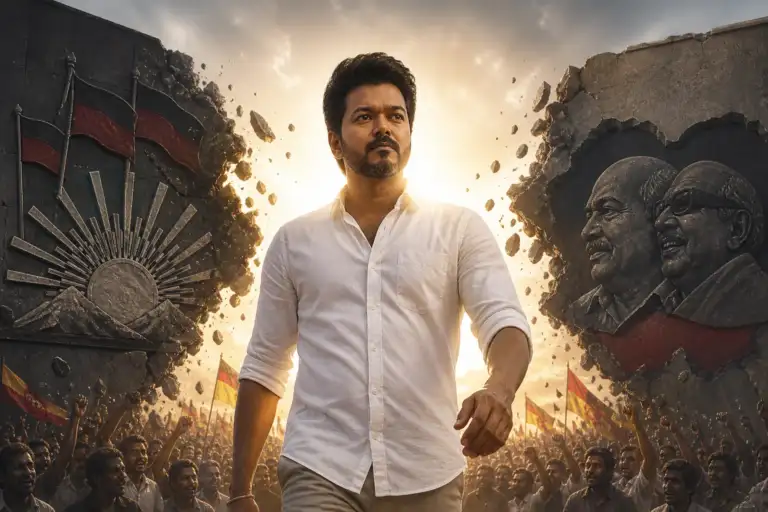
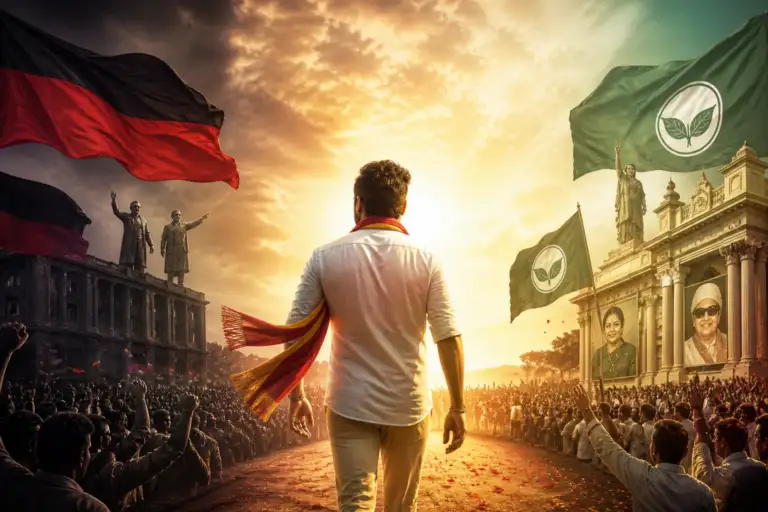
Vijay’s Tamilaga Vettri Kazhagam won 108 seats in the Tamil Nadu Legislative Assembly, contesting all 234 constituencies entirely on its own, without joining any political alliance. The DMK managed 73 seats. The AIADMK alliance came in at 53. For the first time since 1967, Tamil Nadu was looking at a political reality that neither the Rising Sun nor the Two Leaves had authored.
This is that story.
The World Vijay Walked Into
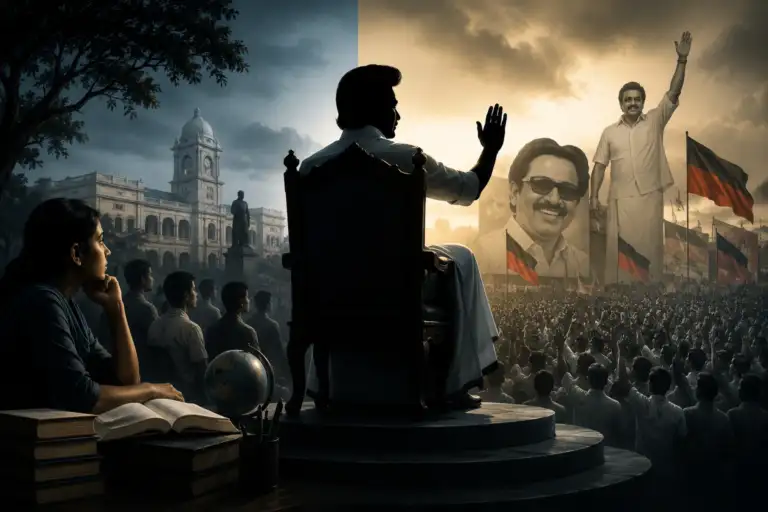
To understand how extraordinary this result is, you have to understand how locked-in Tamil Nadu’s political landscape had been for nearly six decades.
Since 1967, the state has been governed almost exclusively by two parties: the Dravida Munnetra Kazhagam (DMK) and the All India Anna Dravida Munnetra Kazhagam (AIADMK). Power alternated between them in a rhythm so predictable that political analysts could practically draw up electoral calendars in advance. Alliances, sub-alliances, and a web of smaller parties orbiting these two giants became the default architecture of every election cycle.
No party had ever seriously disrupted this arrangement. Several had tried. Most vanished within a cycle or two.
So when Vijay announced on February 2, 2024, that he was launching a new party, the establishment reaction was polite skepticism at best. Even among his own supporters, there was an unspoken question: is this real, or is this a promotional exercise that ends before voting day?
What followed over the next two years answered that question definitively.
Building a Party From Scratch
The Tamilaga Vettri Kazhagam did not grow out of an existing political movement or inherit a legacy structure. It was built ground up, with Vijay essentially converting decades of fan club culture into genuine political organization.
This was not as simple as it sounds. Fan clubs and political parties operate on entirely different logics. One is built on admiration. The other runs on institutional accountability, local network strength, booth-level management, and the ability to mobilize people on a specific day for a specific purpose.
TVK invested heavily in that infrastructure. By February 2025, the party had announced a large-scale enrollment drive and structured plans to place over 70,000 booth agents across the state. That kind of ground presence does not happen through social media momentum alone. It requires sustained organizational effort that most observers outside the party simply did not see building up.
The party held its first major political conference in Vikravandi in October 2024, and the turnout was genuinely staggering. Over 800,000 people attended. For a party less than a year old, that gathering sent a signal that the DMK and AIADMK could not ignore. Both parties reportedly stepped up their own voter outreach efforts in response.
What TVK Actually Stood For
One of the more interesting challenges Vijay faced was ideological clarity. In Indian regional politics, voters tend to reward parties that have a distinct identity beyond promises. The DMK has Dravidian social justice politics. The AIADMK carries the legacy of MGR and later Jayalalithaa. What was TVK?
The answer Vijay gave was thoughtful. The party aligned itself with centre-left politics, drawing inspiration from the philosophies of Ambedkar, Periyar, and Kamaraj. These are not arbitrary name-drops. Each figure represents a specific tradition in Tamil political consciousness: Ambedkar for Dalit rights and constitutional democracy, Periyar for social rationalism and anti-caste politics, and Kamaraj for clean governance and grassroots administration.
At Vikravandi, Vijay framed TVK’s core ideology as secular social justice, egalitarianism, two-language policy, and democracy. He explicitly called the BJP an ideological opponent and the DMK a political adversary, accusing the latter of corruption and dynastic politics. This positioning gave TVK a clear lane: not hard-left, not right-wing, but a reform-oriented social democratic alternative that could credibly challenge both incumbents.
The manifesto that the party released ahead of the election reflected this identity. The document ran to 95 pages and covered welfare delivery, governance reform, and employment generation in considerable detail. Headline promises included a monthly financial assistance of Rs 2,500 for every woman head of household, a complete crop loan waiver for small farmers, a monthly allowance of Rs 3,000 for senior citizens and widows, education loans up to Rs 20 lakh without collateral, and a plan to create 5 lakh village-level jobs through a “CM People Service Associate” programme. For fishermen, the manifesto pledged Rs 27,000 as lean-season relief along with what it described as India’s first statutory Minimum Support Price for fish.
These were not hollow talking points. The specificity of the numbers and the structure of the proposals suggested genuine policy development work rather than campaign-season improvisation.
The Decision to Go It Alone
Perhaps the single most consequential strategic choice Vijay made in the lead-up to the election was announced on March 18, 2026: TVK would contest all seats independently, without joining any major alliance.
In Tamil Nadu’s electoral tradition, this was close to unthinkable for a new party. Alliances spread risk, pool resources, and allow smaller parties to win seats they could not have won alone. Going solo means facing a vote split in every constituency while established parties consolidate their support bases through partner networks.
The conventional political wisdom said this strategy would cost TVK heavily in seat count.
The voters had other ideas.
Contesting alone turned out to be not just a viable strategy but a powerful message in itself. It told voters that TVK was not part of the old bargaining system, was not going to trade principles for seat-sharing arrangements, and was genuinely offering something structurally different from what had come before.
Whether voters consciously processed it that way or responded intuitively to the signal, the effect was real. TVK’s 108 seats represent a remarkable haul for a first-time participant in a multi-party election, especially given that the party started from zero in terms of elected representation.
The Election Day Story
The 2026 Tamil Nadu assembly election was held on April 23. Voter turnout came in at 85.1 percent, the highest ever recorded for a state assembly election in Tamil Nadu. That number alone tells a significant part of the story. When citizens who normally stay home decide to vote, it often signals that something beyond routine preference is at play.
Vijay contested personally from two constituencies: Perambur and Tiruchirappalli East. He won Tiruchirappalli East with a margin of 27,216 votes, securing 91,381 votes in that constituency.
When counting began on May 4, early trends showed TVK leading in constituency after constituency across northern, central, and southern Tamil Nadu, including Chennai, Chengalpattu, Kancheepuram, Thiruvallur, Tiruchirappalli, Thanjavur, Madurai, Dindigul, Theni, Virudhunagar, Tirunelveli, and Kanyakumari. The party had cut across traditional voter blocs, with strong showings particularly among youth and first-time voters.
Final results from the Election Commission confirmed 108 seats for TVK. The DMK-led alliance secured 73. The AIADMK-led alliance finished with 53. TVK had not just won the most seats. It had done so while all the established forces competed against it.
Why This Result Is Genuinely Historic
Numbers tell part of the story. Context tells the rest.
Tamil Nadu has seen actor-politicians before. MGR built the AIADMK in 1972 and went on to serve as chief minister. But MGR came from within the political ecosystem, having spent years in the DMK before breaking away with an existing support base and organizational infrastructure. The comparison often drawn is flawed for that reason.
What Vijay did was different. He built a party from scratch, with no inherited legislature presence, no political family network, and no alliance safety net, and in its very first election, that party emerged as the single largest entity in a 234-seat assembly. In terms of political debut performance, there is genuinely nothing comparable in Tamil Nadu’s modern electoral history.
The broader significance extends beyond Tamil Nadu’s borders. Indian politics has long debated whether voters are willing to support genuinely new political entities that lack the patronage networks and caste arithmetic calculations of established parties. TVK’s performance in 2026 offers a significant data point suggesting that, under the right conditions, they are.
The conditions that made this possible seem to include: a credible ideological identity, a detailed policy platform, strong grassroots organization, and a candidate who generated genuine trust rather than just celebrity recognition.
What Comes Next
With 108 seats, TVK falls ten short of the 118 needed for an outright majority. This means the path to forming a government requires either outside support or a formal arrangement with smaller parties and independents. Vijay himself addressed supporters after the results with confidence, calling the mandate a “people’s victory” and describing it as the beginning of a new political era in Tamil Nadu.
That framing matters. The language of new beginnings is easy to deploy. Whether this moment becomes a genuine inflection point depends on what follows: how TVK governs if it forms a government, whether its organizational depth holds over time, and whether the policy commitments in its 95-page manifesto translate into administrative action rather than electoral memory.
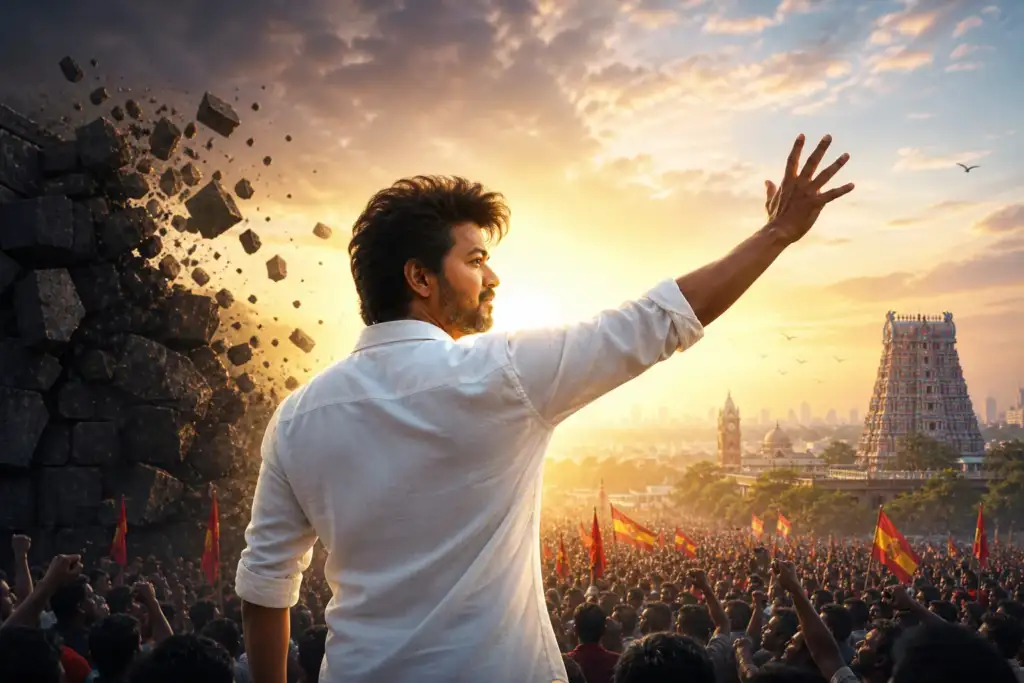
For now, though, a fact stands that nobody can argue with. Joseph Vijay walked into Tamil Nadu politics alone, fielded candidates in every single constituency without making a single alliance deal, and came out on election night as the man who finally broke a political binary that had governed one of India’s most politically sophisticated states for nearly sixty years.
That is not a small thing.
A Note on What Changed
Politics in Tamil Nadu has always involved a particular kind of transaction: parties promised welfare, caste groups delivered votes, alliances distributed the spoils, and the cycle repeated. TVK did not entirely reject this model, as its manifesto is full of welfare commitments. But it layered onto those commitments something that established parties had stopped offering: the credible possibility of clean governance and structural change.
Whether that promise holds under the pressure of actually running a government remains to be seen. But the 85.1 percent of Tamil Nadu voters who showed up on April 23 showed that they still believe something different is possible. They voted for it in numbers that changed the map.
That is where political eras begin.