

Introduction
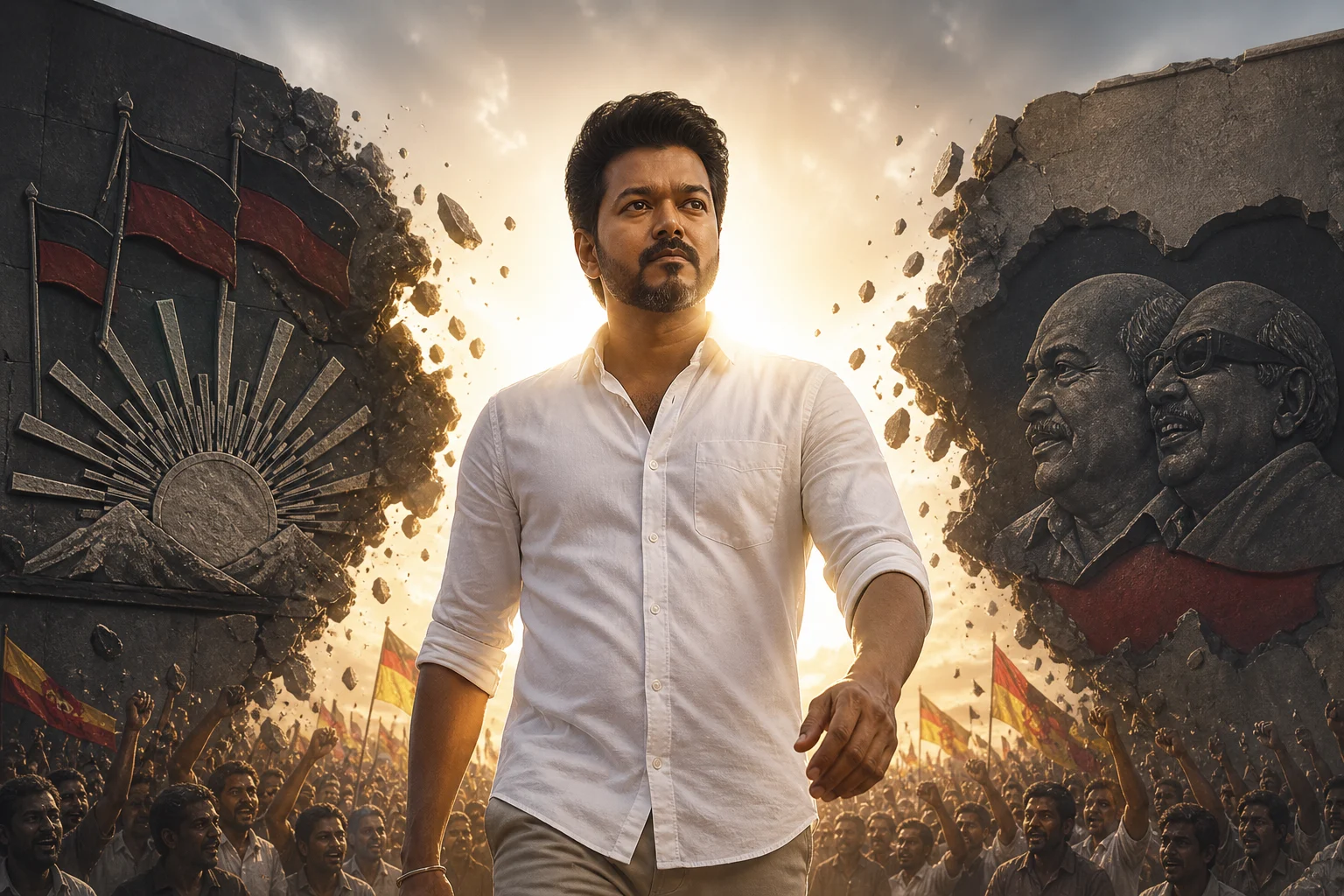
Tamil Nadu politics has followed a predictable script for over five decades. Power alternated between Dravidian parties, ideology remained dominant, and leadership emerged from the same political lineage. The 2026 Assembly election disrupted this continuity. Vijay’s rise was not accidental, emotional, or symbolic; it was structural, strategic, and timed with public fatigue. This shift marked the first credible electoral defeat of Dravidian political dominance in the state.
The Dravidian Political Stronghold: Why It Seemed Unbreakable
Dravidian parties sustained power through ideology, identity, and institutional reach. Their strength rested on three pillars:
- Control over grassroots party machinery
- Long-standing welfare narratives rooted in social justice
- Emotional ownership of Tamil identity and language politics
For decades, challengers failed because they attempted to confront ideology head-on rather than redefine the political frame itself.
The Context Before 2026: Public Fatigue and Political Saturation
By the early 2020s, signs of exhaustion became visible across Tamil Nadu:
- Repetitive leadership faces with limited generational change
- Governance fatigue despite welfare continuity
- Rising youth disengagement from traditional party rhetoric
- Urban voters prioritizing development, jobs, and transparency
This environment created an opening, not for another Dravidian faction, but for an outsider with cultural legitimacy and political restraint.
Vijay’s Strategic Entry Into Politics
Vijay avoided the most common mistake made by celebrity politicians, premature ambition. His approach was phased and disciplined.
Key strategic decisions included:
- Delayed electoral entry to build credibility
- Formation of TVK as a values-based platform rather than a personality cult
- Avoidance of caste-driven rhetoric
- Minimal alliance dependency
Instead of attacking Dravidian ideology, Vijay positioned himself as post-Dravidian, respectful of its legacy but firm on its limitations.
Reframing Tamil Identity Without Dravidian Ideology
One of the most critical shifts came in narrative control. Vijay did not reject Tamil identity; he de-politicized it.
He focused on:
- Tamil pride without linguistic hostility
- Social justice without perpetual victimhood framing
- Governance performance over ideological loyalty
This reframing appealed strongly to first-time voters and urban middle-class families who felt culturally Tamil but politically homeless.
Grassroots Organization Over Rhetoric
Contrary to assumptions, Vijay’s campaign was not driven by cinema popularity alone. It relied on systematic groundwork.
On-ground execution included:
- Booth-level volunteers trained early
- Data-backed constituency targeting
- Youth-driven digital outreach in Tier 2 and Tier 3 towns
- Local issue mapping rather than state-wide generic promises
This operational discipline allowed TVK to compete with decades-old party structures within a short span.
Why Dravidian Parties Failed to Counter Vijay
The failure was not ideological; it was strategic miscalculation.
Dravidian parties:
- Underestimated voter readiness for change
- Over-relied on legacy loyalty
- Failed to modernize communication for younger demographics
- Treated Vijay as a transient phenomenon
By the time the seriousness of the challenge was acknowledged, voter sentiment had already shifted.
Election Outcome: What Made 2026 Different
| Factor | Previous Elections | 2026 Shift |
|---|---|---|
| Voter Motivation | Identity-driven | Performance-driven |
| Youth Participation | Passive | High and decisive |
| Campaign Style | Ideological | Issue-focused |
| Opposition Strategy | Alliance-heavy | Independent mandate |
The result was not a marginal victory; it was a psychological break from political continuity.
Why This Victory Redefined Tamil Nadu Politics
Vijay’s success established several firsts:
- First non-Dravidian leader to decisively defeat Dravidian parties electorally
- First major political shift led by cultural relevance rather than ideology
- First mandate driven by governance expectations over identity politics
This does not signal the end of Dravidian influence; it signals its transformation from dominance to participation.
Conclusion
Vijay’s 2026 victory was not about cinema stardom or protest votes. It was the outcome of strategic patience, narrative recalibration, and voter maturity. Tamil Nadu did not reject its political past; it chose to move beyond it. This election marked the moment when governance reclaimed center stage from ideology.

