Scroll through TikTok or Instagram Reels for more than five minutes right now, and you will likely land on at least one video of someone gliding a small blade across their face in smooth, deliberate strokes. The comments are full of reactions ranging from fascinated to horrified.
Welcome to the dermaplaning moment of 2026.
Dermaplaning is not new. Aestheticians and dermatologists have been offering it as an in-office treatment for years. But the availability of affordable at-home dermaplaning tools, combined with the viral reach of skincare content creators, has turned it into one of the most searched and discussed beauty procedures of the year.
The problem is that TikTok, by its very nature, tends to show the best-case results. The smooth, glowing skin after the procedure. The satisfying close-up of peach fuzz being removed. What it rarely shows in equal measure are the risks, the technique requirements, and the reasons why this is not right for every skin type.
This post gives you the full picture. What dermaplaning is, what TikTok gets right about it, where the popular narrative goes wrong, and how to do it safely at home if you decide it is right for you.
What Is Dermaplaning?
Dermaplaning is a physical exfoliation technique that uses a sterile, single-edge blade to gently scrape the surface of the skin. The process removes two things simultaneously: the layer of dead skin cells that accumulates on the surface, and the fine vellus hair, commonly known as peach fuzz, that covers most of the face.
The result, when done correctly, is a smoother skin surface that reflects light more evenly, giving the appearance of a brighter, more radiant complexion. It also allows skincare products applied afterward to penetrate more effectively, since the layer of dead skin and hair that can block absorption has been cleared away.
In professional settings, dermaplaning is performed by a licensed aesthetician or dermatologist using a surgical-grade scalpel. At-home tools use smaller, safer blades designed specifically for consumer use, with built-in safety guards that reduce the risk of cutting the skin.
What TikTok Gets Right About Dermaplaning
Let us give credit where it is due. The widespread enthusiasm for dermaplaning on social media has introduced millions of people to a legitimately effective skincare technique. Here is what the viral content gets right.
1. The Skin Smoothing Effect Is Real
This is not a placebo or a filter trick. Removing dead skin cells from the surface of the face genuinely improves skin texture. After dermaplaning, skin feels measurably smoother to the touch and looks more even in natural light.
For people who struggle with rough texture, dry patches, or a dull complexion, this improvement can be significant. The results are visible immediately after the procedure and can last for several weeks.
2. Makeup Application Does Improve
TikTok creators are not exaggerating when they show their foundation gliding on more smoothly after dermaplaning. Peach fuzz and surface texture can cause foundation to sit unevenly or emphasise texture rather than cover it. Removing those elements creates a smoother canvas.
This is particularly noticeable with matte and full-coverage foundations, which tend to cling to texture more than lighter formulas.
3. Skincare Absorption Is Enhanced
The claim that dermaplaning improves the absorption of serums and moisturisers is well supported. Without the physical barrier of dead skin cells, active ingredients in your skincare routine have a more direct route to the skin cells that can actually use them.
If you use expensive vitamin C serums, retinoids, or hydrating treatments, this improved penetration means you are getting more value from those products.
4. Peach Fuzz Does Not Grow Back Thicker
This is perhaps the most important thing TikTok gets right, because it is the concern that stops many people from trying dermaplaning in the first place.
Vellus hair (peach fuzz) does not have the same structure as terminal hair (the thicker hair on your head or legs). Removing it does not change its follicle, its growth rate, or its texture. When it grows back, it grows back as fine and soft as it was before. This is not opinion. It is established dermatological fact.
What TikTok Gets Wrong About Dermaplaning
Now for the part that the algorithm tends to bury because it is less satisfying to watch.
1. It Is Not Right for All Skin Types
This is the most significant omission in most viral dermaplaning content. Dermaplaning is not appropriate for everyone, and using it on the wrong skin type can cause real harm.
People with active acne should not dermaplane. Running a blade over inflamed or open breakouts spreads bacteria, damages the skin barrier, and can cause infection and scarring. If you have active spots, wait until they have fully healed before attempting this procedure.
People with rosacea, eczema, very sensitive skin, or any inflammatory skin condition should consult a dermatologist before attempting dermaplaning. The physical exfoliation can trigger flare-ups and worsen existing conditions.
People with keratosis pilaris (a condition that causes small, rough bumps on the skin) should be cautious. Dermaplaning can irritate this condition rather than improve it.
2. Technique Matters More Than TikTok Suggests
Watching a 60-second video makes dermaplaning look effortless. In practice, the technique requires specific attention to angle, pressure, and skin tension that is not easy to learn from a short-form video.
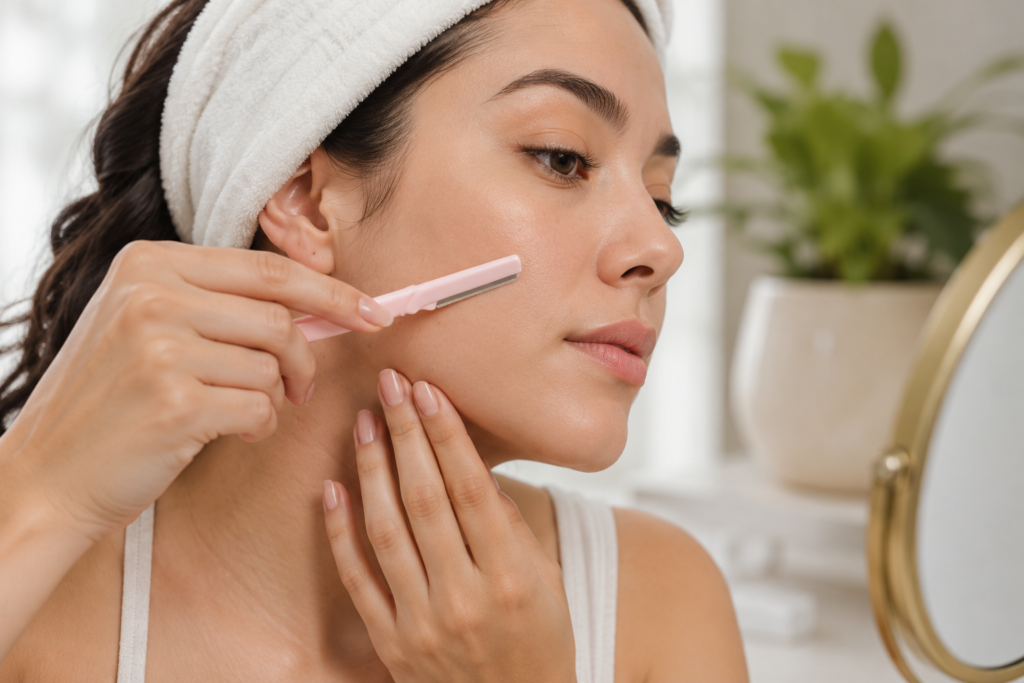
The blade needs to be held at approximately a 45-degree angle to the skin surface. Too steep and it risks cutting. Too flat and it will not exfoliate effectively. The skin needs to be held taut with the non-dominant hand, and the strokes should be short, gentle, and downward.
Most at-home tools have safety guards that make serious injury unlikely, but poor technique can still result in minor cuts, irritation, and uneven results.
3. The Wrong Blade Is a Problem
Not all at-home dermaplaning tools are equal, and the cheapest options on the market are not always the safest. TikTok frequently features sponsored content from budget razor brands that may use blades that are not designed for full-face dermaplaning.
Look for tools specifically marketed for facial dermaplaning, with a safety guard, a single-edge blade, and clear instructions. Avoid repurposing eyebrow shapers or body razors for the face.
4. Aftercare Is Not Optional
This is where a lot of at-home dermaplaning goes wrong. After removing the surface layer of your skin, your face is temporarily more sensitive to sunlight, harsh products, and environmental irritants.
Many people who experience redness, irritation, or breakouts after dermaplaning did not follow proper aftercare. The skin needs gentle, hydrating products immediately after the procedure. Vitamin C serums, retinoids, acids, and anything with alcohol should be avoided for at least 24 to 48 hours. Sunscreen is absolutely essential for the days following dermaplaning, as the freshly exposed skin burns more easily.
How to Dermaplane at Home Safely: A Step-by-Step Guide
If you have determined that dermaplaning is appropriate for your skin type and you want to try it at home, here is how to do it correctly.
What You Need
- A dedicated facial dermaplaning tool with a safety guard
- A gentle, non-foaming cleanser
- A light facial oil or dry skin surface (dermaplaning is done on dry skin)
- A gentle hydrating serum or moisturiser for aftercare
- SPF 30 or higher for the following days
Step 1: Cleanse Thoroughly
Wash your face with a gentle cleanser and pat it completely dry. Do not apply any moisturiser or serum before you begin. Dermaplaning is performed on clean, dry skin. Any product on the skin will interfere with the blade’s ability to make clean contact.
Step 2: Hold the Skin Taut
Use your non-dominant hand to gently pull the skin taut in the area you are working on. This reduces the risk of the blade catching on loose skin and helps ensure an even exfoliation.
Step 3: Hold the Blade at 45 Degrees
Position the blade at approximately a 45-degree angle to your skin. This is the critical technique element. Start with a small, inconspicuous area of your face to get a feel for the angle and pressure before moving to more prominent areas.
Step 4: Use Short, Downward Strokes
Use light, short, downward strokes. You should not be pressing hard. Let the weight of the tool and the angle of the blade do the work. Work in sections across the face: cheeks, forehead, chin, upper lip area.
Avoid the eye area entirely. The skin is too thin and too close to the eye for safe dermaplaning at home.
Step 5: Rinse and Apply Hydrating Products
After finishing, rinse your face with cool water and pat dry. Apply a gentle hydrating serum and a moisturiser. Avoid active ingredients for the next 24 to 48 hours.
Apply sunscreen before going outside, and reapply it as you normally would during the day.
How Often Should You Dermaplane?
For most skin types, once every three to four weeks is appropriate. This gives the skin time to complete its natural renewal cycle before you remove the next layer of surface cells. Dermaplaning more frequently can disrupt the skin barrier and cause sensitivity.
When to See a Professional Instead
At-home dermaplaning works well as a maintenance tool for people with normal to dry skin who want to maintain smooth texture between other treatments. But there are situations where a professional treatment is the better choice.
If you have significant skin texture issues, deep acne scarring, or hyperpigmentation, an in-office dermaplaning treatment performed by a licensed aesthetician or dermatologist will deliver significantly better results. Professionals use surgical-grade tools that provide a more thorough treatment than any at-home device can match.
If you are combining dermaplaning with other treatments such as chemical peels or microneedling, those combinations should always be supervised by a skincare professional.
Final Thoughts
Dermaplaning is a legitimate, effective skincare technique that deserves its moment in the spotlight. For the right skin type, used with proper technique and followed by appropriate aftercare, it delivers real improvements in skin texture, radiance, and product absorption.
TikTok has done the beauty community a genuine service by making this technique more widely known. But like everything that goes viral, the algorithm tends to amplify the impressive before-and-after shots and skip the nuance.
Know your skin type before you pick up a blade. Learn the technique before you apply it to your whole face. Take the aftercare seriously. And if you have any doubts about whether dermaplaning is right for you, book a consultation with a dermatologist before you begin.
Your skin will thank you for the extra five minutes of research.