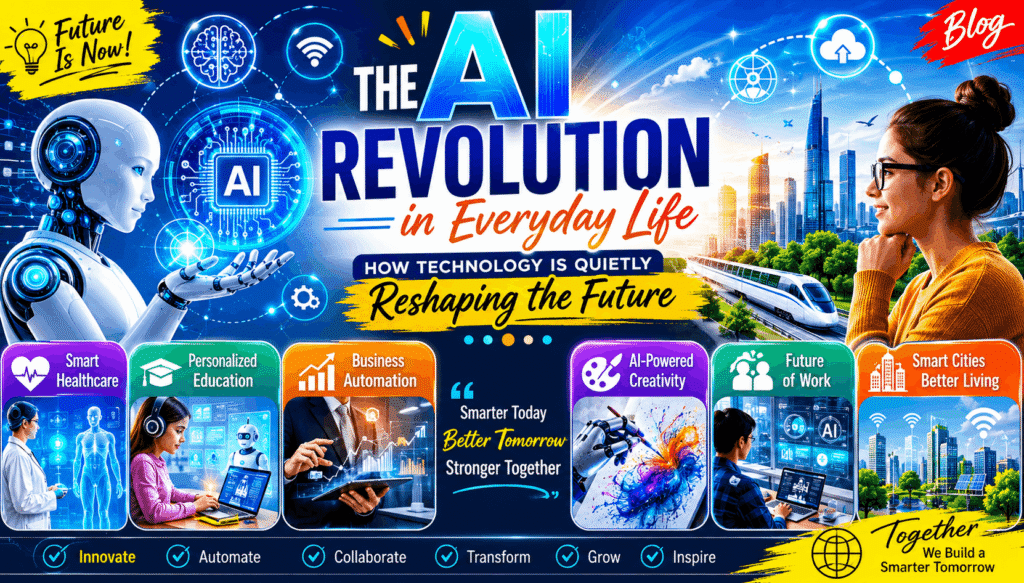
A major technological transformation is taking place around the world. While previous innovations often focused on hardware, machines, or infrastructure, today’s biggest change is happening through artificial intelligence (AI). What once seemed like a futuristic concept found only in science fiction movies is now becoming part of everyday life. From smartphones and online shopping to healthcare, education, transportation, and business operations, AI is influencing how people work, learn, communicate, and make decisions. The technology is advancing rapidly, creating new opportunities while also raising important questions about privacy, employment, and ethics. Experts believe that the current wave of AI innovation could become one of the most significant technological shifts of the century, comparable to the invention of the internet itself.
AI Is No Longer a Future Technology
For many years, artificial intelligence was viewed as an experimental technology used primarily by researchers and large corporations. Today, however, it has become widely accessible. Millions of people interact with AI-powered tools every day without even realizing it. Virtual assistants answer questions, recommendation systems suggest products and entertainment, navigation apps optimize travel routes, and smart devices automate household tasks. The growing accessibility of AI tools has enabled individuals, students, freelancers, entrepreneurs, and businesses to accomplish tasks more efficiently than ever before. This shift has transformed AI from a specialized technology into a practical everyday resource.
Businesses Are Embracing Automation
One of the biggest impacts of AI can be seen in the business world. Companies are using intelligent systems to automate repetitive tasks, improve customer service, analyze large datasets, and enhance decision-making processes. AI-powered chatbots can now handle thousands of customer inquiries simultaneously, reducing response times and improving customer satisfaction.
Marketing teams use AI to understand consumer behavior and create personalized experiences. Financial institutions rely on machine learning models to identify fraud and assess risks. Manufacturing companies employ AI-driven systems to optimize production and predict equipment maintenance needs. As organizations continue adopting automation, productivity gains are becoming increasingly significant. However, experts emphasize that successful implementation requires balancing technological efficiency with human oversight.
Transforming Education and Learning
Education is experiencing one of the most exciting AI-driven transformations. Students can now access personalized learning platforms that adapt to individual strengths and weaknesses. These systems provide customized lessons, practice exercises, and feedback based on learning progress. Teachers are also benefiting from automation tools that help manage administrative work, evaluate assignments, and identify areas where students may need additional support.
Online learning platforms have expanded access to education, allowing people from different backgrounds to acquire valuable skills regardless of their location.
Many educational institutions are integrating AI literacy into their curricula, recognizing that future generations will need to understand how intelligent technologies function and influence society.
Healthcare Is Becoming Smarter
The healthcare sector is witnessing remarkable advancements through artificial intelligence. Medical professionals use AI-powered systems to analyze diagnostic images, detect diseases earlier, and improve treatment planning. Researchers are leveraging machine learning algorithms to accelerate drug discovery and identify potential medical breakthroughs. Wearable health devices can monitor vital signs in real time, helping individuals track their wellness and detect potential health concerns before they become se rious.
Hospitals are also using predictive analytics to manage resources more efficiently and improve patient outcomes. While AI is not replacing healthcare professionals, it is becoming a powerful tool that supports better medical decision-making and enhances patient care.
The Rise of AI-Powered Creativity
One of the most surprising developments in recent years is the emergence of AI-generated creative content. Artificial intelligence can now assist with writing articles, generating images, composing music, creating videos, and designing graphics. Creative professionals are increasingly incorporating AI tools into their workflows to enhance productivity and explore new ideas.
Rather than replacing human creativity, many experts believe AI serves as a collaborative partner that expands creative possibilities. Writers can generate content drafts more quickly, designers can experiment with concepts faster, and musicians can explore innovative compositions. This combination of human imagination and machine intelligence is creating entirely new forms of digital creativity.
Challenges and Ethical Concerns
Despite its benefits, AI also presents significant challenges.
One major concern involves data privacy. Intelligent systems often rely on large amounts of information to function effectively, raising questions about how personal data is collected, stored, and used. Another concern is algorithmic bias. If AI systems are trained on incomplete or biased datasets, they may produce unfair or inaccurate results. There are also concerns regarding misinformation. Advanced AI tools can generate highly realistic text, images, audio, and videos, making it increasingly difficult to distinguish between authentic and manipulated content.
Governments, technology companies, and researchers are working together to develop ethical guidelines and regulations that promote responsible AI development. Building public trust remains a critical priority.
The Future of Work
Perhaps the most discussed impact of AI involves the workforce. Automation is expected to change the nature of many jobs. Routine and repetitive tasks are increasingly being handled by intelligent systems, allowing employees to focus on more complex and strategic responsibilities. While some roles may become obsolete, new opportunities are emerging in areas such as AI development, cybersecurity, data science, machine learning, digital marketing, and technology management.
Experts suggest that adaptability and continuous learning will become essential skills in the modern economy. Workers who embrace technological change and develop digital competencies are likely to remain highly competitive in the evolving job market.
Smart Cities and Connected Communities
Urban development is also being transformed through AI-powered technologies. Smart traffic management systems can reduce congestion and improve transportation efficiency. Intelligent energy grids help optimize electricity consumption and support sustainability goals.
Public services are becoming more responsive through data-driven insights that help authorities allocate resources effectively. Environmental monitoring systems use AI to track pollution levels, predict natural events, and support conservation efforts. These innovations contribute to creating safer, more sustainable, and better-connected communities.
Why AI Matters to Everyone
Artificial intelligence is no longer limited to technology experts or large corporations. Its influence extends across virtually every aspect of modern life.
Whether someone is shopping online, studying for an exam, receiving medical care, creating content, or managing a business, AI is increasingly shaping the experience. Understanding how these technologies work can help individuals make informed decisions and adapt to future changes. The ability to use AI responsibly may become as important as digital literacy is today.
Conclusion
The AI revolution is not a distant possibility it is already underway. Intelligent technologies are transforming industries, improving efficiency, expanding access to knowledge, and creating new opportunities for innovation. At the same time, important questions about ethics, privacy, transparency, and employment must be addressed to ensure that progress benefits society as a whole.
As artificial intelligence continues to evolve, its impact will likely become even more profound. The organizations and individuals that embrace learning, adaptability, and responsible innovation will be best positioned to thrive in this rapidly changing landscape. The future is being shaped today, and AI is playing a central role in defining what comes next.