New York is putting its AI safety law into practice. On Tuesday, November 10, the state opened a registration portal for large frontier AI developers, including OpenAI and Anthropic, which must register under the RAISE Act by January 1, 2027, according to TechCrunch. Governor Kathy Hochul also launched a state-run center to test advanced AI systems, which Engadget describes as the nation’s first state-run AI testing program. This site is not affiliated with OpenAI or Anthropic, and neither company’s response was included in the coverage reviewed.
Who is covered. The act applies to large frontier developers, defined as companies with more than $500 million in annual revenue, according to TechCrunch. They must publish safety frameworks on their websites, issue public transparency reports on their models, and report critical safety incidents within 72 hours. A new Office of Digital Innovation, Governance, Integrity, and Trust, known as DIGIT, will implement the law and oversee the labs.
The penalties. Violations can bring fines of up to $1 million for a first violation and up to $3 million for later ones, according to TechCrunch. The state can take enforcement action against companies that fail to register, but a spokesperson declined to give specifics. The article does not say whether the penalties are per day.
The testing center. The New York Center for AI Responsibility and Research, at SUNY Binghamton, will independently evaluate advanced AI systems and work with DIGIT on companies’ safety frameworks, according to TechCrunch. Engadget says more than 80 New York scientists will contribute and that computing power comes from Empire AI, the state’s $500 million public-private AI partnership. TechCrunch says the governor first announced the center in January with $55 million in donations and capital.
What officials said. Quoted by Engadget from a press release, the governor said the stakes are too high to simply take AI companies at their word. At a press briefing, the governor also said, in words quoted by TechCrunch, that tech moguls tell us their vision for AI is inevitable, and added that it is a matter of getting on board or getting left behind.
The limits. Engadget points out that the center can only study what AI companies disclose publicly, and says the RAISE Act will not close the gap on unreleased models. That means independent testing depends on what labs choose to release.
How it compares. TechCrunch notes that California’s SB 53 took effect in January and requires safety frameworks, whistleblower protections and critical incident reports within 15 days, a longer window than New York’s 72 hours. Illinois SB 315 takes effect at the start of 2027 and adds independent safety compliance audits. New York also has a companion-chatbot law and signed a minors’ chatbot law in October that takes effect on June 1, 2027.
Why it matters. States are setting their own rules, and a patchwork of requirements is forming for companies that operate nationwide. Faster incident reporting and published safety frameworks give regulators and the public more to examine. For readers in the US and UK, it shows how AI oversight is being built from the state level up.
Sources: TechCrunch and Engadget. Details are as reported by those outlets and New York officials.
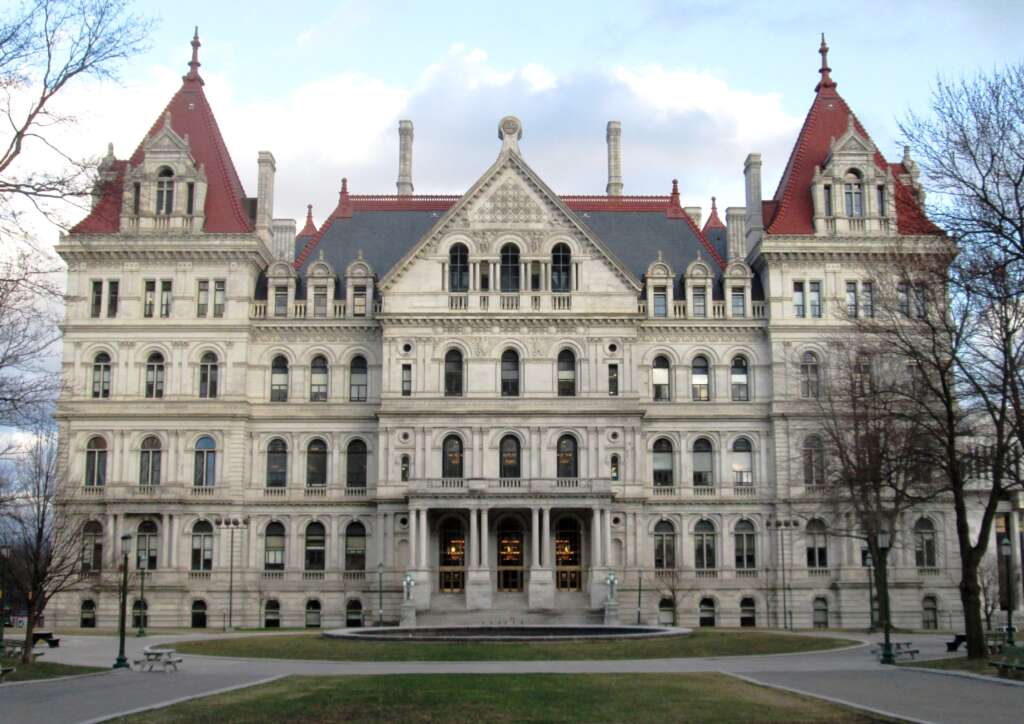
New York State Capitol, Albany (file image), Wikimedia Commons, CC BY-SA 4.0