
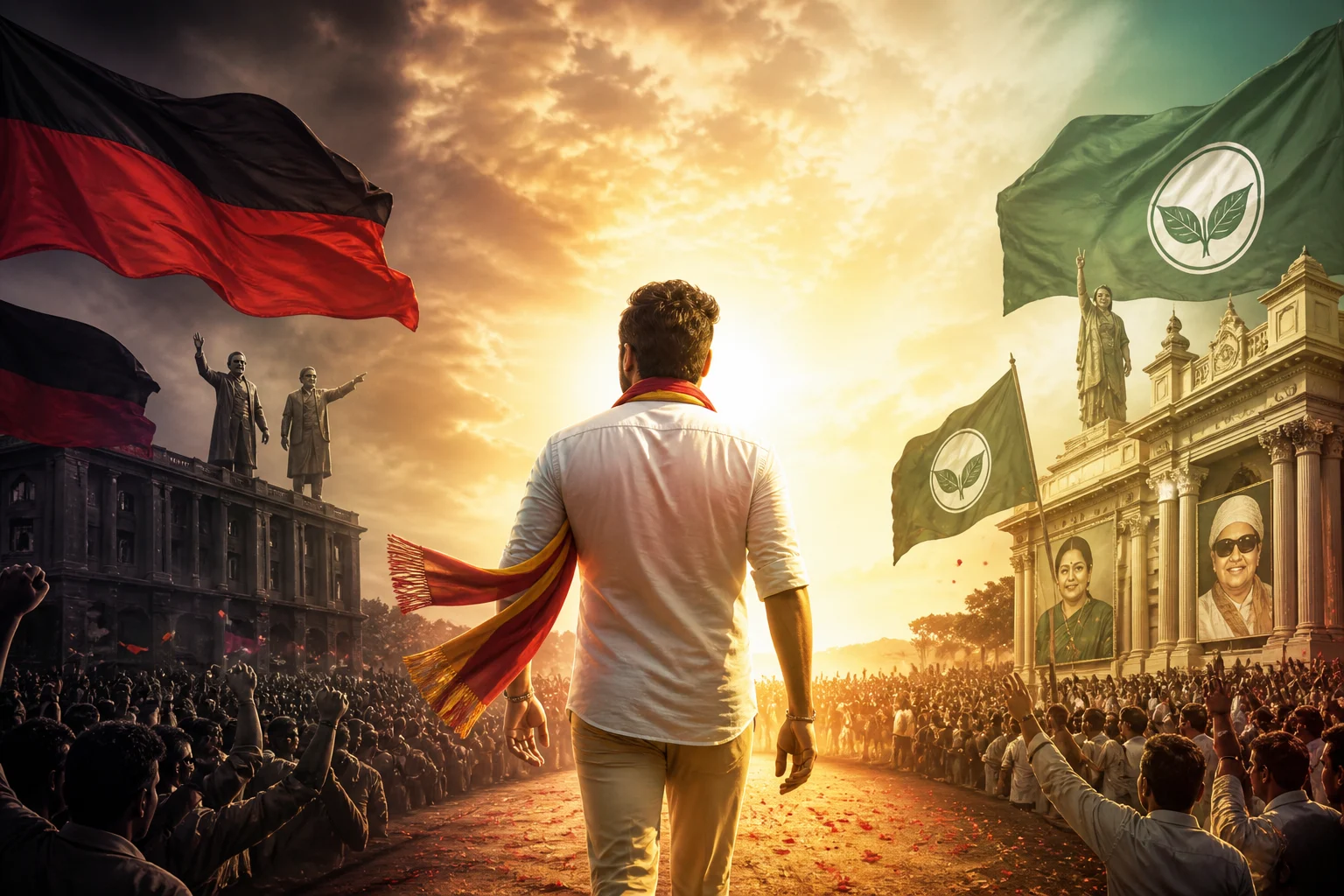

Before We Talk About Vijay, We Need to Talk About What He Walked Into
Picture Tamil Nadu’s political map for the last six decades. Two colors. Two names. Two parties that swapped power back and forth like clockwork, each holding the state for a term or two before giving way to the other, and then taking it back again.
The DMK founded in 1949, shaped by the intellectual fire of C.N. Annadurai and later steered by the formidable M. Karunanidhi, built its identity on Dravidian ideology, social justice, Tamil pride, and a vision of governance rooted in grassroots politics. It gave Tamil Nadu its first non-Congress chief minister. It rewrote how political power was talked about, distributed, and legitimized in the state.
Then in 1972 came the split. M.G. Ramachandran, arguably the most beloved public figure Tamil Nadu had ever produced, broke away from the DMK and formed the AIADMK. When MGR led his new party to a sweeping victory in 1977, winning 130 of 234 assembly seats, he did something genuinely unprecedented in Indian democratic history. He turned personal charisma, cinematic identity, and mass devotion into elected power. His midday meal scheme, subsidized food programs, and welfare-first governance earned him a loyalty that bordered on reverence. After MGR came Jayalalithaa, who consolidated the AIADMK’s hold through multiple terms as chief minister, adding her own chapter of populist welfare schemes and iron-willed administration.
Between these two giants, Tamil Nadu’s political imagination was essentially occupied. Every election was a question of which party had the better combination of alliance arithmetic, welfare promises, and voter consolidation. No new entrant had ever seriously broken through. Several had tried. None had lasted.
Then came 2026.
What the DMK Had: Power
When Vijay announced his political party on February 2, 2024, the DMK was the sitting government. M.K. Stalin had led the party to a convincing 159-seat majority in 2021, and the machinery of incumbency was fully operational. The DMK had state resources, an extensive grassroots network built over decades, and the organizational infrastructure that comes from being one of India’s oldest and most battle-tested regional parties.
The DMK also had something subtler but equally important. It had the language of social justice built into its DNA. Periyar, Ambedkar, Kamaraj, the anti-caste movement, Tamil cultural assertion, these were not slogans for the DMK. They were the original architecture of the party’s identity, carried across generations of political workers who genuinely believed in them even as critics pointed to the gap between ideology and governance practice.
In the months leading up to the 2026 election, the DMK ran an aggressive campaign. Stalin launched a massive enrollment drive, urging cadres to onboard at least 30 percent of voters in each booth to the party through door-to-door outreach. The party had ground presence. It had administrative experience. It had the state apparatus.
What it struggled with, as TVK’s campaign made increasingly clear, was trust. Vijay repeatedly attacked what he called the “30% Stalin Tax,” a reference to allegations of corruption and leakage in public welfare delivery. Whether or not voters accepted the specific framing, the underlying question resonated: had power, held for five years, been used honestly?
What the AIADMK Had: Legacy
The AIADMK carried something that cannot be manufactured or purchased: a 50-year emotional legacy built on the names of MGR and Jayalalithaa, two figures who occupy a place in Tamil public consciousness that goes well beyond politics.
MGR was not just a chief minister. He was a cinematic deity who walked off screen and into governance without ever fully leaving his screen persona behind. The welfare schemes he introduced, particularly the midday meal program that fed millions of schoolchildren, became so deeply woven into Tamil Nadu’s social fabric that they outlasted him by decades. For a generation of Tamil voters, especially older ones from rural and lower-income backgrounds, the AIADMK name still carries that warmth.
Jayalalithaa added another layer. Her governance had its share of controversy, but she also delivered scale. The Amma canteens, the Thalikku Thangam scheme, the sheer ambition of her welfare architecture left marks that her successors continue to reference.
The problem for the AIADMK heading into 2026 was that legacy, no matter how powerful, does not automatically translate into present-tense trust. The party had gone through internal fractures, leadership disputes, and the difficult transition of operating without either of its iconic figures. Edappadi K. Palaniswami had consolidated control and reunited with the BJP for the 2026 contest, but the coalition came with its own complications given Vijay’s explicit positioning of the BJP as an ideological opponent.
Legacy is a form of inherited capital. It earns you the first hearing. But it does not guarantee the vote.
What Vijay Had: Something Else Entirely
Here is the honest answer to the question this headline asks. What Vijay had was not power. He had never held office. What he had was not legacy in the institutional sense. His party was barely two years old when it filed its first candidate list.
What Vijay had was trust, and specifically the kind of trust that neither power nor legacy can manufacture.
This is worth unpacking carefully because it is the actual engine of what happened on May 4, 2026.
Tamil Nadu’s 2026 electorate included over 1.22 crore voters between the ages of 18 and 29, making up 21.2 percent of the total electorate. More than 14 lakh of these were first-time voters. This is a generation that grew up watching Vijay not just as an entertainer but as a specific kind of cultural figure: someone whose screen persona consistently championed the ordinary person against corrupt systems, whose films like Sarkar in 2018 imagined an honest outsider cleaning up a broken political establishment, and whose real-world actions, from cycling to his polling booth in 2021 in quiet protest against fuel prices to announcing his retirement from Rs 275 crore film fees to enter public service, communicated something that political speeches rarely do.
They communicated sincerity.
Vijay’s speeches during the campaign did not sound like traditional political oratory. At his first major political conference in Vikravandi in October 2024, attended by over 800,000 people, he asked the crowd directly: “Isn’t it selfish to just think that only I should live well? Beyond a certain limit, what is one supposed to do with the money we earn? How am I going to repay the people who gave me life?” That is not the language of a politician calculating a vote bank. That is the language of someone working through a genuine public commitment in front of witnesses.
Young voters heard that differently from how they heard the established parties speak. They had seen the DMK’s governance. They knew the AIADMK’s history. Both parties spoke the language of the people because it was politically necessary. Vijay spoke it because the alternative, staying in cinema collecting industry-record fees, was still available to him. The sacrifice was visible and real.
The Trust Architecture TVK Built
Trust as a political asset is fragile and specific. It cannot be claimed. It can only be demonstrated over time through consistent action that aligns with stated values.
TVK’s two-year journey from announcement to election showed several moments of that alignment.
When 41 people died in a stampede at a TVK rally in Karur in September 2025, Vijay did not issue a press release and move on. He paid Rs 2 million to each victim’s family from his own funds, personally visited families in Mamallapuram a month later to express condolences, and cooperated with investigations that followed. The response was not perfect, and critics raised legitimate questions about organizational preparedness. But the personal accountability Vijay showed stood in sharp contrast to how political tragedies are typically handled in Indian public life.
When the party released its manifesto, the document ran to 95 pages. The specificity was not accidental. Collateral-free education loans up to Rs 20 lakh, a concrete Rs 27,000 lean-season relief for fishermen, a legally backed Minimum Support Price for fish described as India’s first of its kind, a plan to create 5 lakh village-level jobs through a named programme rather than a vague promise. Voters who read it found a party that had done its homework. That too is a form of trust-building.
The decision to contest all 234 seats alone, announced March 18, 2026, was perhaps the clearest signal of all. In Tamil Nadu’s alliance-heavy political culture, going solo is an act of either extraordinary confidence or extraordinary commitment. It told voters: we are not trading your interests in a seat-sharing negotiation. We are here for you, not for leverage.
What the Numbers Actually Say
The 2026 Tamil Nadu assembly election recorded a voter turnout of 85.1 percent, the highest ever for a state assembly election in Tamil Nadu. That number deserves to sit on its own for a moment. When people who normally stay home decide to show up, it means something has changed in how they feel about the stakes.
TVK finished with 108 seats, the single largest bloc in the 234-seat assembly. The DMK alliance won 73. The AIADMK alliance came in at 53. For a party contesting its very first election, against two parties with combined institutional histories spanning more than seven decades, these numbers represent something the political science textbooks do not have a clean category for.
TVK’s surge was not confined to one region or demographic. The party made strong inroads across Chennai and urban belts, traditionally DMK strongholds. It performed well in central Tamil Nadu strongholds like Tiruchirappalli, where Vijay won personally with a 27,216-vote margin. It drew first-time voters and youth in numbers that shifted margins in constituencies across northern, southern, and coastal Tamil Nadu.
The party’s candidates were predominantly young and politically inexperienced, which in a different context would be a liability. In this election, it was read as authenticity. A party fielding first-timers to represent first-time voters is practicing what it preaches.
The Gap Between Power and Trust
Here is what the 2026 result actually illuminates about modern Tamil politics.
Power, as the DMK demonstrated, gives you incumbency, resources, and administrative leverage. But five years of governance always produces a gap between what was promised and what was delivered. In a state where voters are sophisticated, informed, and increasingly connected, that gap gets measured in real time.
Legacy, as the AIADMK’s performance showed, gives you emotional inheritance and brand recognition. But legacy is backward-looking by nature. It answers the question of what a party once stood for. It struggles to answer what it stands for today and who exactly is carrying that torch.
Trust, the thing Vijay had, answers a different question entirely. It answers: do I believe this person means what he says? Do I believe he will still mean it after the election? Do I believe the sacrifice was real?
In 2026, with a record 85.1 percent of Tamil Nadu’s voters turning out, enough of them answered yes to give a two-year-old party 108 seats against machines that had been running for decades.
That is what power cannot buy. That is what legacy cannot inherit.
That is what Vijay had.
What Comes Next
With 108 seats, TVK sits 10 short of the 118 needed for an outright majority. The path to government likely runs through some form of outside support, with the Congress considered the most probable source of post-poll backing. Vijay himself, addressing supporters after the results, framed the mandate as a “people’s victory” and called it the beginning of a new political era.
Whether this era holds depends entirely on what happens after the votes are counted and the cameras leave. Trust, once granted by voters, is not renewed automatically. It is earned again, and again, through governance that matches the language of the campaign.
The DMK and AIADMK both know this lesson from experience. Now Vijay will have to learn it too.
For a deeper look at how Vijay broke the sixty-year Dravidian duopoly and what his solo victory means for Tamil Nadu’s political future, read our full analysis: [Breaking the Binary: Joseph Vijay and the Dawn of a New Political Era in Tamil Nadu].


1 Comment