|
Getting your Trinity Audio player ready... |
More than a decade after entering the national political spotlight, Narendra Modi remains one of the most politically dominant leaders in independent India’s history. Despite economic headwinds, global uncertainties, opposition alliances, and persistent criticism from sections of the media and civil society, Modi continues to command electoral victories and public attention at a scale unmatched by any contemporary rival. The question is no longer whether Narendra Modi is powerful but why he remains politically unchallenged.
The answer lies not in a single factor, but in a convergence of leadership style, narrative control, opposition weakness, voter psychology, and structural changes in Indian politics.
1. Modi as a Political Brand, Not Just a Leader
Narendra Modi is not merely a prime minister; he is a political brand. Unlike earlier leaders who relied heavily on party ideology or legacy networks, Modi positioned himself as a self-made leader who rose from modest beginnings. This personal narrative resonates deeply in a country where aspiration often outweighs ideology.
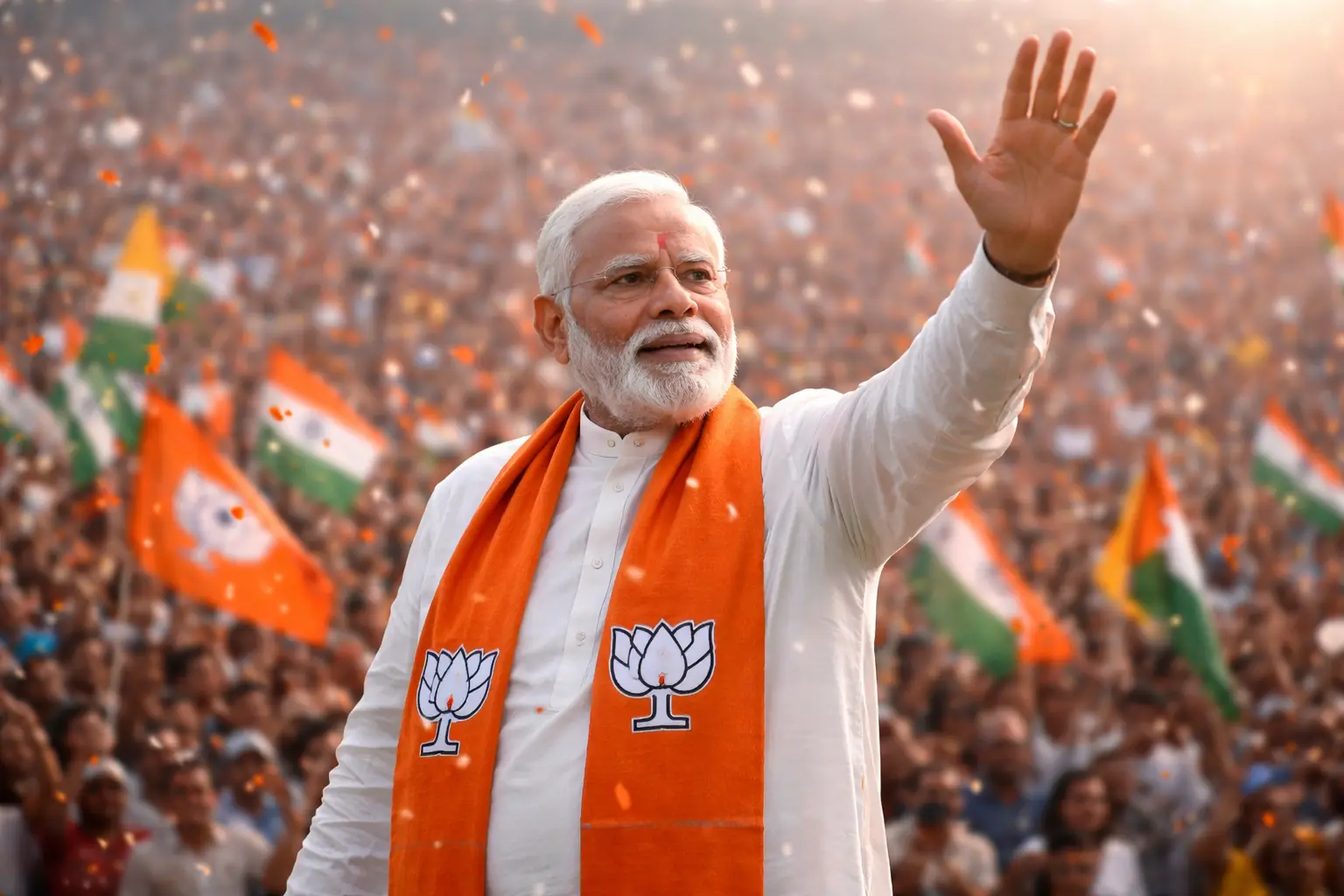
Modi’s brand combines authority, accessibility, and symbolism. His speeches, attire, slogans, and public appearances are carefully crafted to reinforce an image of decisiveness and moral clarity. Voters may disagree with policies, but they rarely question who is in charge. That perception of control is a powerful political asset.
2. Weak and Fragmented Opposition
A dominant leader thrives when the opposition lacks coherence and Modi’s era has been defined by exactly that. India’s opposition parties have struggled to present a credible, unified alternative leadership. Coalitions often appear reactive rather than visionary, united primarily by opposition to Modi rather than a shared national agenda.
Leadership vacuum is a critical issue. While opposition parties may have capable administrators and regional stalwarts, none have emerged as a pan-India figure who can match Modi’s mass appeal, communication skills, or perceived authority. Elections are increasingly presidential in nature, and Modi consistently wins that comparison.
3. Mastery Over Political Communication
Narendra Modi understands communication better than any Indian leader before him. From radio programs like Mann Ki Baat to social media outreach and mass rallies, Modi bypasses traditional gatekeepers and speaks directly to citizens.
This direct communication achieves two things. First, it humanizes power, creating a sense of personal connection with voters. Second, it allows Modi to frame national conversations on his terms, whether the topic is nationalism, development, welfare, or global leadership. Control over narrative often translates into control over political momentum.
4. Welfare Politics With Visibility
Contrary to the belief that Modi’s politics is purely ideological, welfare delivery plays a central role in sustaining his dominance. Schemes related to housing, sanitation, cooking gas, healthcare, and direct benefit transfers have created tangible touchpoints between the state and citizens.
What sets these initiatives apart is visibility. Welfare programs are explicitly branded and communicated, ensuring beneficiaries associate improvements in daily life with Modi’s leadership. This reinforces loyalty, especially among first-time beneficiaries and rural voters, who see the government as present and responsive.
5. Nationalism as an Emotional Anchor
Modi’s political messaging consistently ties governance to national pride. Whether through foreign policy, defense decisions, or cultural symbolism, nationalism serves as an emotional anchor that transcends policy debates.
For many voters, supporting Modi is not just a political choice but a statement of identity. This emotional alignment makes electoral challenges harder because opposition critiques are often perceived as attacks on national interest rather than policy disagreements.
6. Electoral Strategy and Organizational Strength
The Bharatiya Janata Party’s electoral machinery under Modi is data-driven, disciplined, and relentless. Booth-level organization, voter analytics, and message consistency give the BJP a structural advantage that few parties can match.
Importantly, Modi’s personal popularity amplifies the party’s reach. Even in state elections, his presence can override local anti-incumbency, turning elections into referendums on his leadership rather than regional governance.
7. Perception of Stability in Uncertain Times
In an era marked by economic volatility, global conflicts, and rapid technological change, many voters prioritize stability over experimentation. Modi is seen as a known quantity strong, predictable, and experienced on the global stage.
This perception matters. Voters may acknowledge flaws or unmet expectations, but they often ask a simple question: Who else can lead the country right now? Until the opposition answers that convincingly, Modi’s position remains secure.
Power Sustained by Structure, Not Luck
Narendra Modi’s political dominance is not accidental. It is the result of deliberate brand-building, narrative control, organizational strength, and the opposition’s inability to adapt to a transformed political landscape.
To challenge Modi effectively, opponents must do more than criticize policies or form alliances. They must present a compelling leadership alternative, master modern political communication, and reconnect with voter aspirations beyond anti-Modi rhetoric.
Until that happens, Narendra Modi will remain not just electorally successful but politically unchallenged.