|
Getting your Trinity Audio player ready... |
Language politics in India remains one of the most enduring and complex dimensions of the country’s democratic framework. With hundreds of languages and dialects spoken across regions, linguistic identity is not merely a cultural marker; it is deeply intertwined with power, access, and political representation. The debate surrounding language politics in India often oscillates between two competing claims: preservation of cultural identity and the risk of systemic exclusion.
India’s constitutional architecture attempted to balance this diversity by recognizing multiple official languages while allowing states to adopt their own linguistic policies. The Eighth Schedule of the Constitution lists 22 officially recognized languages, signaling an intent to protect linguistic plurality. However, constitutional recognition alone has not eliminated political friction. Instead, language has frequently become a mobilizing tool in electoral politics, governance, and social movements.
ALSO READ – Why Indian Culture Treats Women as Symbols, Not Individuals
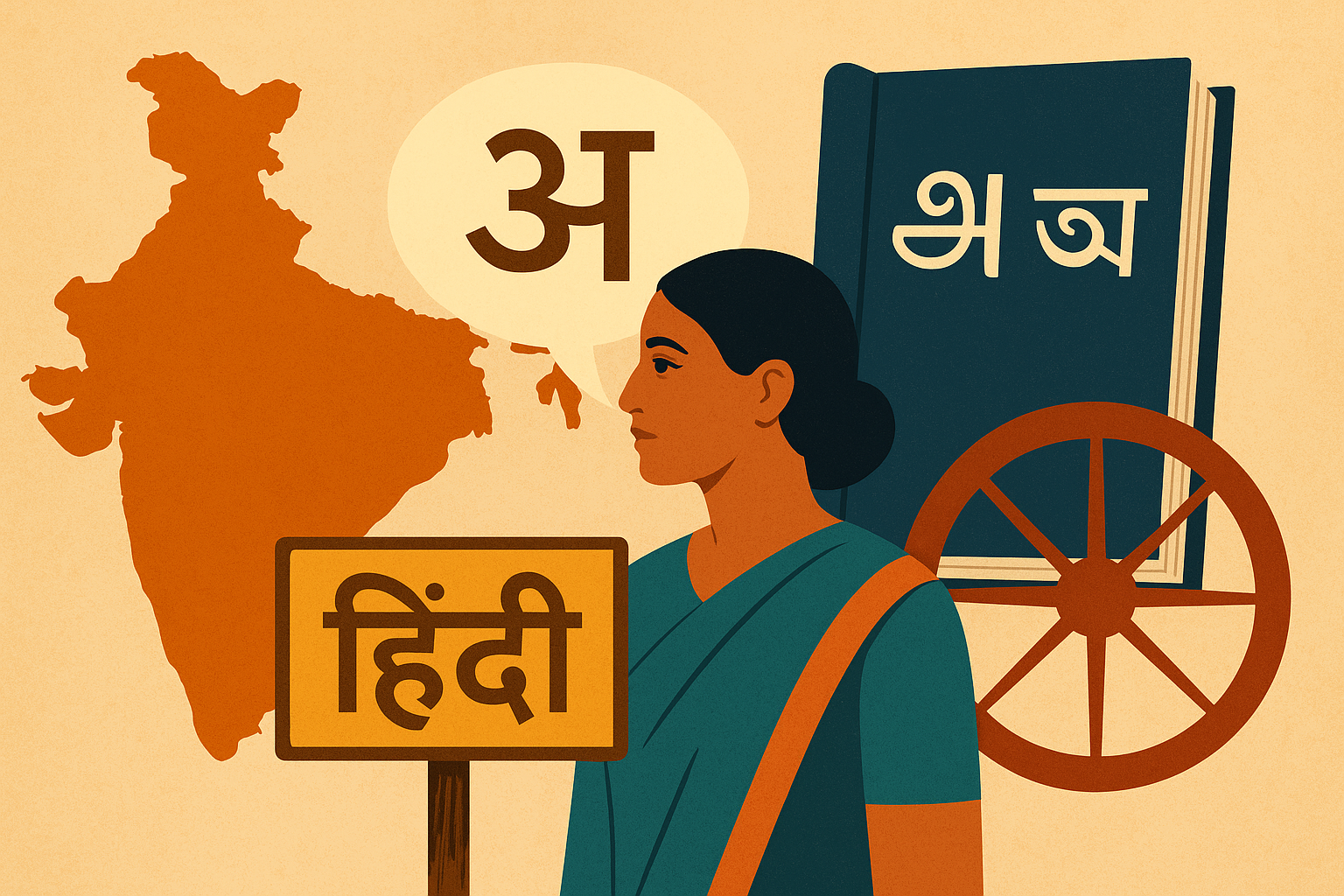
A central axis of language politics in India is the role of Hindi. Promoted as an official language of the Union, Hindi has often been framed as a unifying medium. Supporters argue that a common language facilitates administrative efficiency, national integration, and mobility. Critics counter that such promotion risks marginalizing non-Hindi speakers, particularly in southern and northeastern states where linguistic identities are historically strong. This tension has periodically erupted into protests, most notably in Tamil Nadu, where resistance to perceived Hindi imposition has shaped state and national politics for decades.
Education policy further illustrates the fault lines in language politics in India. The three-language formula was designed to ensure linguistic balance by promoting regional languages alongside Hindi and English. In practice, implementation has been uneven. English continues to function as a gatekeeper language, offering access to higher education, global employment, and social mobility. Regional language speakers without English proficiency often face structural disadvantages, raising questions about whether linguistic diversity is genuinely accommodated or selectively rewarded.
Employment and competitive examinations present another layer of exclusion. National-level recruitment exams conducted primarily in Hindi and English can disadvantage candidates from regions where other languages dominate daily life and schooling. While translation mechanisms exist, disparities in quality and accessibility persist. As a result, language politics in India intersects directly with economic opportunity, reinforcing perceptions of unequal treatment among linguistic communities.
ALSO READ – Why Indian Culture Treats Women as Symbols, Not Individuals
Media and digital platforms have intensified linguistic debates rather than neutralizing them. Algorithm-driven content often amplifies regional language nationalism, reinforcing echo chambers. Political actors increasingly deploy language as a symbol of authenticity and resistance, framing linguistic pride as a defense against cultural homogenization. While such narratives can empower marginalized communities, they can also deepen regional polarization when framed in oppositional terms.
At the same time, it would be reductive to view language politics in India solely through the lens of exclusion. Linguistic reorganization of states in the 1950s was a democratic response to popular demands, not an authoritarian imposition. It allowed governance to align more closely with cultural realities, improving administrative responsiveness and political participation. Regional language promotion has preserved literary traditions, oral histories, and local knowledge systems that might otherwise have been eroded.
The challenge lies in managing linguistic diversity without transforming it into a zero-sum contest. Effective language policy requires flexibility rather than uniformity. Multilingual governance, improved translation infrastructure, and equitable representation of languages in education and administration are pragmatic steps. Crucially, language must be treated as an enabling resource rather than a hierarchical filter for citizenship and competence.
ALSO READ – Patriotism or Policing? When Culture Becomes a Loyalty Test
Language politics in India ultimately reflects broader questions about the nature of unity in a plural society. Unity built on accommodation and mutual recognition differs fundamentally from unity imposed through standardization. The persistence of linguistic debates suggests that identity preservation and systemic exclusion are not mutually exclusive outcomes; they coexist depending on policy design and political intent. The direction India takes will depend on whether linguistic diversity is governed through inclusionary federalism or instrumentalized for short-term political gain.
ALSO READ – Religion in India: Faith, Identity, or Instrument of Power?
In a multilingual democracy, language should function as a bridge, not a barrier. The future of language politics in India will be judged not by the dominance of any single language, but by the extent to which all citizens can participate equally regardless of the language they speak.