|
Getting your Trinity Audio player ready... |
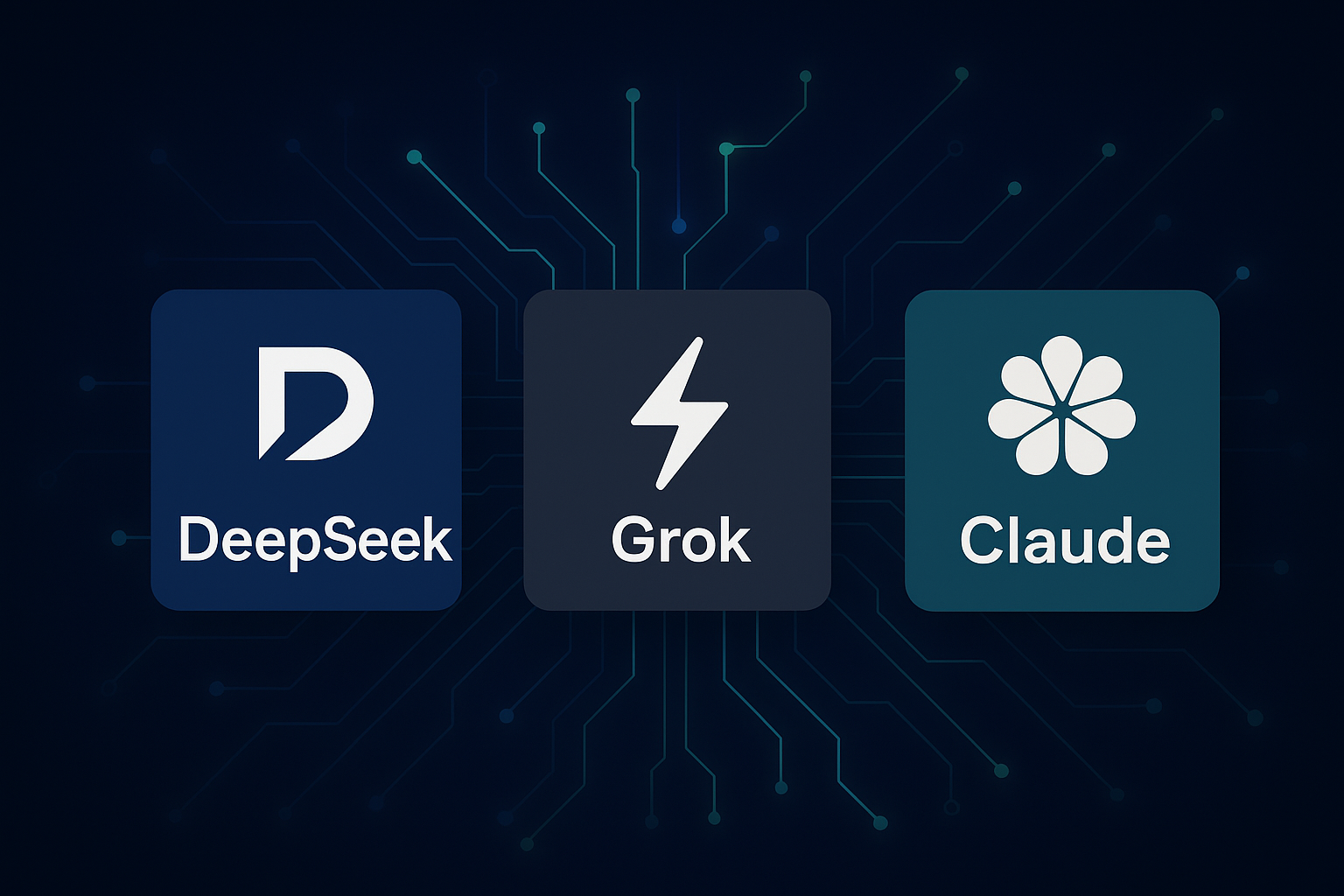
The race for artificial intelligence dominance has intensified in 2025; the global market is now centered on a handful of highly capable AI assistants. DeepSeek, Grok and Claude represent three distinct strategies for scaling model performance; each system demonstrates unique advantages in reasoning, speed and deployment efficiency. The competition has reshaped industry priorities, particularly in model architecture, inference optimization and API accessibility.
DeepSeek has gained significant traction due to its aggressive open release schedule. Models such as DeepSeek R1 and DeepSeek V3 introduced a training strategy that prioritizes efficiency over raw parameter count. DeepSeek’s approach reduces dependence on extensive GPU clusters, and this characteristic has attracted developers who require predictable inference costs. The DeepSeek AI Assistant positions itself as a high-accuracy reasoning engine suitable for research applications, enterprise automation and real-time problem solving. API usage has increased sharply since the release of R1, supported by improved latency and a more consistent response framework.
Grok, supported by xAI, follows a contrasting philosophy; it focuses on rapid real-world updates, high-volume data throughput and a conversational tone. Model performance on dynamic information retrieval benchmarks remains strong because Grok integrates fast indexing pipelines with continuous refresh cycles. This capability makes Grok attractive for users who prioritize current information; however, benchmark tests indicate that its long-form analytical reasoning trails behind DeepSeek and Claude. Grok compensates for this gap through speed; inference times remain among the fastest in the market, especially when deployed with optimized hardware stacks powered by NVIDIA GPUs.
Claude, developed by Anthropic, retains its position as a stability-focused model with strong performance on structured reasoning, summarization and multi-document analysis. Claude’s most recent models achieve high scores on safety benchmarks and legal writing tasks. The model architecture is optimized for reliability; the assistant avoids hallucination more effectively than most competitors. Combined with Anthropic’s emphasis on constitutional AI, Claude continues to be favored by enterprise clients who require predictable behavior for compliance-driven workflows. Although Claude’s inference speed is slower than Grok’s, its precision in domain-specific tasks sets a consistent standard for professional use cases.
NVIDIA remains central to this competitive landscape; the company provides the hardware backbone for most large model deployments. Its accelerated compute solutions have enabled faster scaling of DeepSeek and Grok clusters; OpenAI and Anthropic also rely heavily on the same infrastructure. With the introduction of next-generation tensor cores, NVIDIA has reduced training times for large transformer systems and reinforced its role as the primary supplier for AI data centers. As a result, performance benchmarks across these assistants are increasingly influenced by NVIDIA’s hardware evolution rather than model architecture alone.
OpenAI maintains influence despite not being the direct focus of this comparison. Its tool ecosystem continues to define baseline expectations for AI assistant behavior. Even as DeepSeek and Grok gain attention, many API developers still integrate OpenAI endpoints as foundational components. Industry analysts expect this multi-model environment to continue; developers prefer combining specialized agents rather than relying on a single dominant system.
Benchmarking results across DeepSeek V3, Grok and Claude illustrate a broader trend in artificial intelligence: specialization now matters more than scale alone. DeepSeek leads in computational efficiency and analytical depth; Grok leads in speed and real-time updating; Claude leads in reliability and structural reasoning. Users select models according to purpose rather than hype. This diversification signals a mature phase for AI development, where precision, context management and inference cost determine market value.
The competition between these models will intensify throughout 2025. Increased API adoption, rapid hardware improvement and expanding enterprise demand will pressure each provider to refine its strategy. DeepSeek’s efficient architecture, Grok’s real-time intelligence and Claude’s structured reasoning will shape the next wave of artificial intelligence benchmarks.