
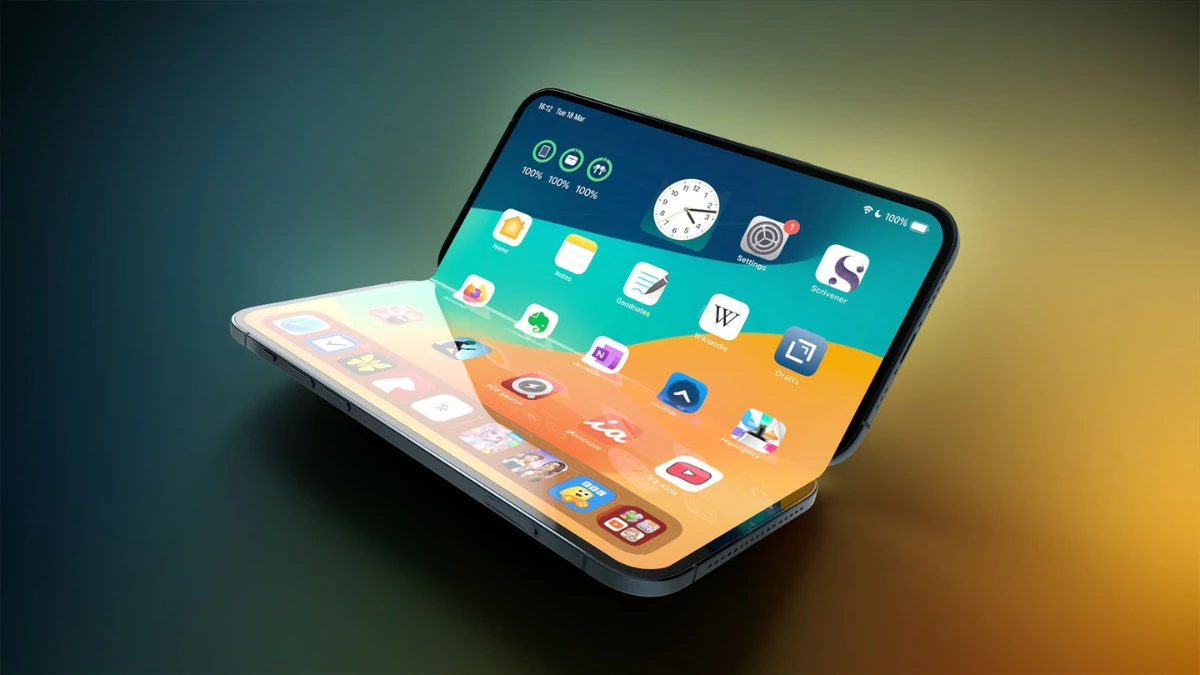

Apple is preparing to launch its new smartphone, which is expected to be its first-ever foldable iPhone. According to recent leaks, this device could feature the largest battery in iPhone history. This development has the potential to establish a new benchmark for battery performance within the smartphone industry.
Industry sources and supply chain leaks indicate that the battery capacity of this device could reach up to 5500 mAh. This foldable device, which many are referring to as the “iPhone Fold,” is rumoured to carry a battery far larger than any previous iPhone model. If this information proves accurate, it would surpass all previous iPhone battery capacities and could even outperform high-end competitors. In such a scenario, Apple’s foldable iPhone could surpass premium smartphones from brands like Samsung and Google, especially in battery performance, if real-world optimization meets expectations.
Record-Breaking Battery Rumours Shake Up Expectations
Reports suggest, and trusted leakers have also claimed, that the iPhone Fold’s battery capacity could range from 5,400 mAh to 5,800 mAh. Some sources further speculate that the final engineering version could approach 6,000 mAh once development and optimization are complete.
For comparison, Apple’s current largest-battery iPhone, the iPhone 17 Pro Max, reportedly carries a battery capacity of around 5,088 mAh. If these rumours materialize, it clearly indicates that Apple is prioritizing battery life as a core focus of this foldable device.
At present, most foldable smartphones on the market, including the Samsung Galaxy Z Fold series and the Google Pixel Fold, have battery capacities of approximately 4,400-5,015 mAh. If Apple introduces a foldable iPhone with significantly higher battery capacity, it would put the company far ahead in endurance and power efficiency within the foldable segment.
Why Battery Life Matters for Foldable Phones
Developing a standard smartphone is manageable, but engineering a foldable phone is significantly more complex. Foldable devices contain two displays: an outer screen and a large inner folding display, both of which consume substantial power. This naturally leads to faster battery drainage, making battery optimization a critical challenge.
Solving this problem requires more than just a large battery. It demands deep hardware and software optimization. Reports suggest that Apple is not only increasing battery size but also focusing heavily on power efficiency. This includes:
- Advanced display power management
- Energy-efficient internal components
- Next-generation battery technology
- Highly optimized software performance
These efforts indicate that Apple’s objective is to deliver a foldable device with long battery life even under heavy use. One of the biggest concerns among foldable phone users has always been battery performance, which has made many consumers hesitant to adopt foldable devices. If Apple successfully resolves this issue, the iPhone Fold could become a true game-changer in the foldable market.
Design, Features and Other Expectations
Beyond battery performance, several rumours are circulating regarding the design and features of the iPhone Fold:
- A book-style foldable design, featuring a large inner display and a functional outer screen
- High-density battery cells combined with a next-generation Apple chipset
- A strong and durable hinge mechanism designed to maintain structural integrity while preserving a slim profile
- New design possibilities for the camera layout
- Some leaks suggest the absence of Face ID, with side-button Touch ID potentially being introduced instead
All of this information is currently based solely on leaks and industry rumours. Apple has not officially confirmed any specifications or design elements.
Launch Timing and Market Strategy
Industry experts believe that Apple could launch its foldable iPhone in late 2026, alongside the iPhone 18 series. Some analysts also suggest that due to technological complexity and supply chain challenges, the launch could be delayed until early 2027.
Apple’s entry into the foldable smartphone market could represent a transformative moment for the global smartphone industry. Experts believe that Apple’s participation could lead to:
- Faster adoption of foldable smartphones
- Accelerated technological innovation
- More advanced manufacturing processes
- Intensified market competition
Apple’s strategic focus on battery performance could prove to be a brilliant move, as battery life has consistently been the weakest point of foldable smartphones.
What Consumers and Tech Enthusiasts Are Saying
Discussions on social media platforms are already intensifying, with users expressing intense excitement about the iPhone Fold. The battery-related rumours, in particular, have generated overwhelmingly positive reactions.
Users believe that if Apple truly delivers a foldable device with strong real-world battery performance, it could become:
- An ideal device for business professionals
- A premium option for power users
- A reliable solution for heavy daily usage
At the same time, many users also acknowledge that a large battery alone is not sufficient. Real-world performance will ultimately depend on software optimization, system efficiency, and power management. Therefore, final judgments will only be possible after the official launch and real-world usage testing.


