|
Getting your Trinity Audio player ready... |
After 25 years of contentious negotiations, European Union member states have formally backed a controversial trade agreement with the Mercosur bloc of Latin American countries, prompting immediate and widespread protests from farmers across the continent. The historic deal promises to create one of the world’s largest free trade zones but faces fierce opposition from agricultural sectors fearing devastating competition.
The EU-Mercosur agreement encompasses the European Union’s 27 member states and Mercosur’s four full members: Argentina, Brazil, Paraguay, and Uruguay. Together, these nations represent a combined market of over 700 million people and significant global economic influence. The deal aims to eliminate tariffs on billions of dollars worth of goods and services traded between the regions.
European Commission President Ursula von der Leyen celebrated the agreement as a milestone achievement. “This partnership represents shared values, economic opportunity, and strategic cooperation,” von der Leyen declared. “It demonstrates that multilateral trade agreements remain possible even in challenging times.”
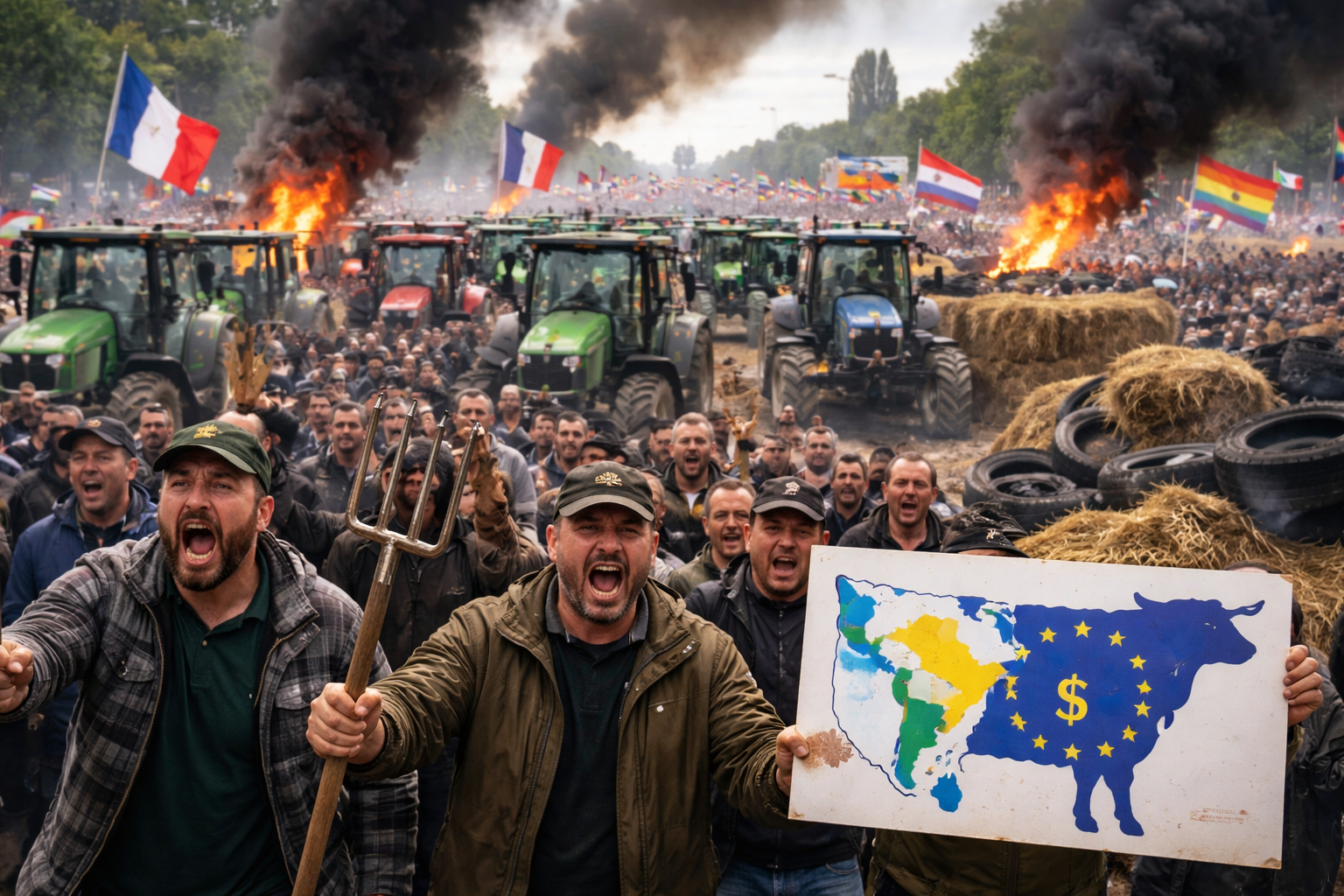
However, the deal’s approval has triggered furious reactions from European agricultural communities who view the agreement as an existential threat. Thousands of farmers descended on Paris, Brussels, and Warsaw in coordinated protests, blocking roads with tractors and burning effigies of political leaders who supported the deal.
French farmers are particularly incensed by provisions allowing increased imports of South American beef, poultry, and agricultural products. “This agreement sacrifices European farmers on the altar of industrial interests,” said Michel Laurent, president of France’s National Federation of Agricultural Holders’ Unions. “We cannot compete with Brazilian production standards that would be illegal here.”
Environmental organizations have joined farmers in opposing the deal, citing concerns about deforestation and climate impacts. Critics argue that increased agricultural exports from Mercosur countries will accelerate Amazon rainforest destruction and undermine European environmental commitments. “This trade deal makes a mockery of Europe’s climate goals,” stated Greenpeace EU’s Jorgo Riss.
The agreement includes provisions meant to address environmental concerns, including commitments to uphold the Paris Climate Agreement and protect forests. However, skeptics question whether these clauses contain sufficient enforcement mechanisms, pointing to Brazil’s inconsistent record on rainforest protection.
European industrial sectors have largely supported the deal, viewing it as an opportunity to expand exports of manufactured goods, pharmaceuticals, and services to growing Latin American markets. German automotive manufacturers and French aerospace companies are expected to benefit significantly from reduced tariffs and regulatory barriers.
Mercosur countries see the agreement as vital for economic development and diversification away from excessive dependence on Chinese markets. Brazilian President Luiz Inácio Lula da Silva praised the deal as recognition of South America’s economic importance and potential.
The agreement still faces potential obstacles before full implementation. Some member states, including France and Poland, have expressed reservations and may seek additional protections for their agricultural sectors. The European Parliament must also ratify the deal, where opposition remains significant.
Political analysts note the agreement’s approval reflects shifting EU priorities toward securing strategic trade partnerships amid global economic uncertainty. However, the strength of opposition suggests implementation may face continued challenges and potentially destabilizing political consequences in rural communities across Europe.
The protests in European capitals show no signs of abating, with agricultural unions promising sustained campaigns to either block the deal’s ratification or secure substantial compensation packages for affected farmers. As tractors continue rolling through city streets, the EU faces a critical test of whether it can balance economic ambitions with domestic political realities.