|
Getting your Trinity Audio player ready... |
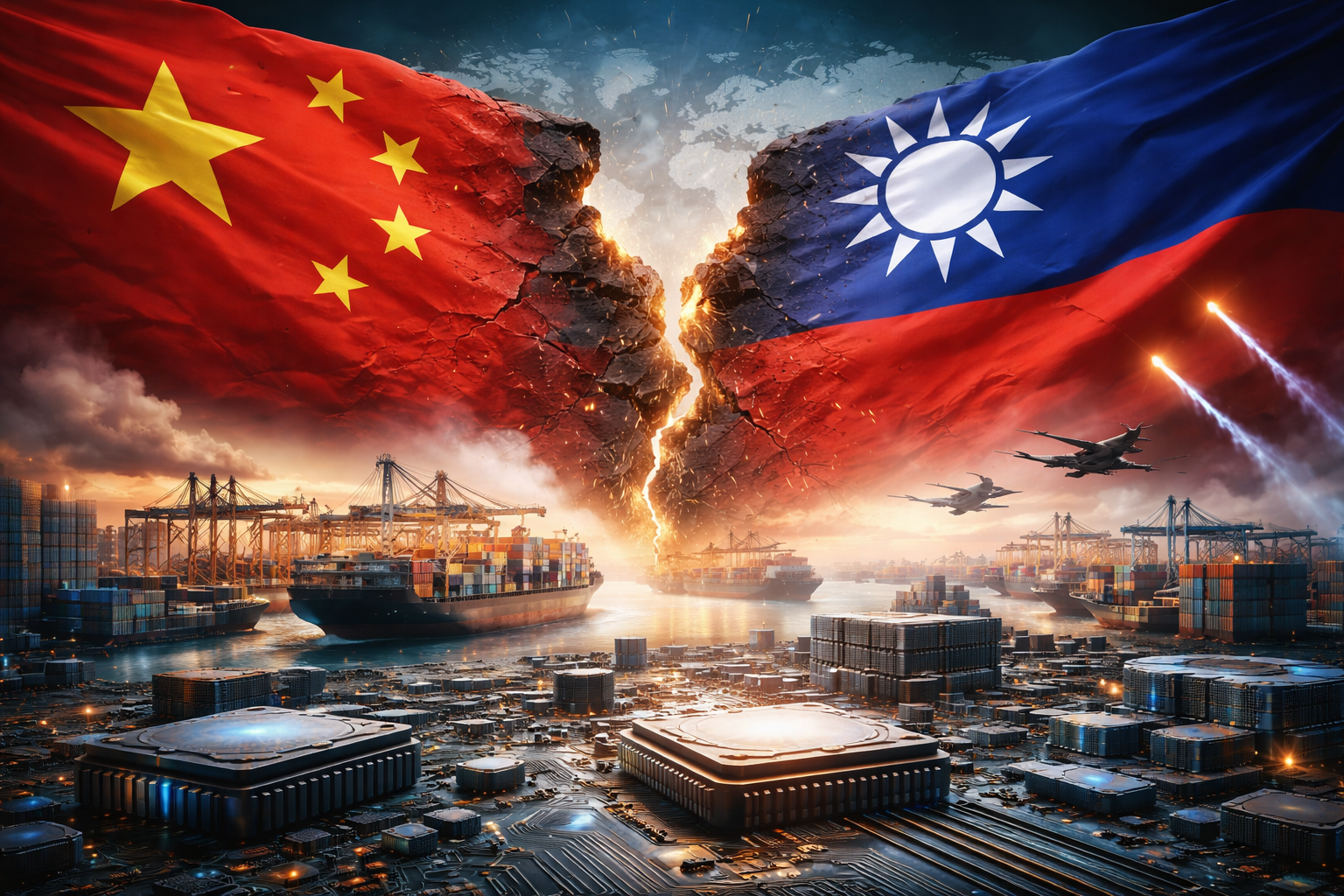
Escalating tensions between China and Taiwan are sending alarm bells ringing across global boardrooms, as the potential for conflict in the Taiwan Strait threatens to disrupt the technology supply chains upon which the modern world depends. Taiwan’s dominance in semiconductor manufacturing particularly advanced chips powering everything from smartphones to artificial intelligence systems makes the island’s security a critical concern for economies worldwide.
Recent months have witnessed increased Chinese military activity around Taiwan, including large-scale naval exercises, air incursions into Taiwan’s air defense identification zone, and aggressive rhetoric from Beijing regarding “reunification.” Chinese President Xi Jinping has repeatedly emphasized that Taiwan’s integration with mainland China is inevitable and that China reserves the right to use force if necessary. Taiwan’s democratically elected government firmly rejects subordination to Beijing, maintaining that the island’s future must be determined by its 23 million citizens.
The United States faces delicate strategic calculations regarding Taiwan. While maintaining a policy of “strategic ambiguity” about whether it would defend Taiwan militarily, the U.S. has significantly increased arms sales to Taipei and strengthened diplomatic engagement. The Trump administration’s approach to China-Taiwan relations remains subject to intense speculation, with statements suggesting both transactional flexibility and hard-line positioning depending on context. This uncertainty itself contributes to regional instability as nations struggle to predict American responses to potential contingencies.
Japan and South Korea, U.S. treaty allies with significant economic interests in regional stability, are bolstering defense capabilities and coordination. Japan has explicitly identified Taiwan’s security as directly relevant to its own national security a remarkable statement given historical sensitivities. Australia has similarly strengthened defense partnerships, recognizing that conflict in the Taiwan Strait would fundamentally disrupt trade routes essential for its export-dependent economy.
The semiconductor industry represents the crisis’s sharpest economic edge. Taiwan Semiconductor Manufacturing Company (TSMC) produces approximately 90% of the world’s most advanced chips technology critical for advanced computing, artificial intelligence, and defense systems. Any disruption to TSMC’s operations would cascade through global supply chains, potentially halting production of smartphones, automobiles, computers, and countless other products. Industry analysts estimate that a Taiwan Strait conflict could cause $1 trillion in immediate economic losses, with far longer-term impacts on technological development.
Recognizing this vulnerability, nations are pursuing semiconductor supply chain diversification with unprecedented urgency. The United States has allocated tens of billions through the CHIPS Act to incentivize domestic semiconductor manufacturing. TSMC is constructing fabrication facilities in Arizona, though these won’t match Taiwan’s production capacity for years. Europe’s European Chips Act similarly aims to reduce dependence on Asian semiconductor production. However, replicating Taiwan’s ecosystem of suppliers, expertise, and manufacturing capabilities represents a decade-long endeavor at minimum.
Beyond semiconductors, Taiwan’s role in electronics manufacturing extends to components, assembly, and testing services that underpin global tech industry supply chains. Apple, Nvidia, AMD, and virtually every major technology company relies on Taiwanese suppliers. The island’s ports handle massive volumes of maritime trade, and any conflict would likely disrupt shipping throughout the region, affecting everything from energy imports to agricultural commodities.
China’s own economic interests complicate military calculations. Taiwan represents a significant trading partner, and Chinese companies depend on Taiwanese technology inputs. An invasion would almost certainly trigger severe economic sanctions from Western nations, potentially cutting China off from critical technologies and financial systems. Nevertheless, analysts warn against assuming economic interdependence guarantees peace, noting that leaders sometimes prioritize nationalist objectives over economic rationality.
Military analysts assess that China possesses growing capabilities to threaten Taiwan through various scenarios ranging from economic coercion and cyberattacks to blockades and amphibious invasion. Taiwan’s military, while technologically sophisticated, faces overwhelming numerical disadvantages. The island’s defense strategy emphasizes making any attack sufficiently costly to deter Beijing while hoping for international intervention if deterrence fails.
Diplomatic efforts to reduce tensions face fundamental obstacles. China refuses negotiations that treat Taiwan as a separate entity, while Taiwan rejects frameworks that presume eventual unification. Track-two dialogues and business relationships provide limited communication channels, but official high-level engagement remains absent. The risk of miscalculation where military posturing escalates beyond intended signaling into actual conflict represents a persistent danger.
The international community’s response to China-Taiwan tensions will shape not only the region’s future but broader principles of sovereignty, territorial integrity, and the rules-based international order. As military capabilities evolve and political dynamics shift, the Taiwan Strait remains one of the world’s most dangerous potential flashpoints.