|
Getting your Trinity Audio player ready... |
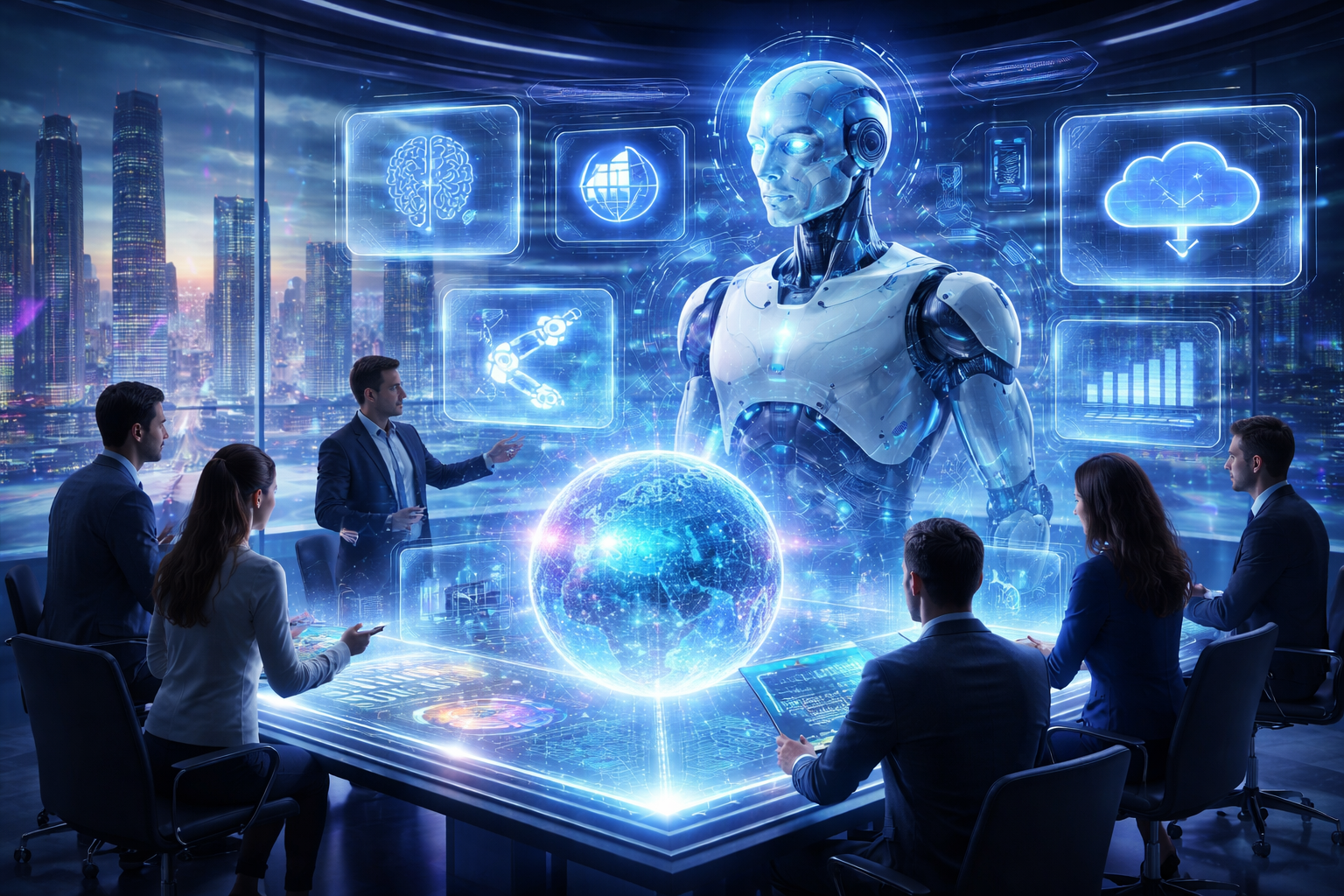
Artificial Intelligence is no longer a future-facing concept it is now a core driver of competitive advantage. As we move into 2026, AI is transitioning from experimental adoption to enterprise-wide execution, fundamentally reshaping how organizations design business strategy, optimize operations, and engage customers.
From AI automation to enterprise-grade intelligence systems, the latest AI trends in 2026 are forcing leaders to rethink digital transformation at scale. Below are the seven most impactful AI trends that will redefine business strategy in the coming year.
1. Enterprise AI Moves From Pilot to Core Infrastructure
In 2026, AI in business will no longer sit on the sidelines as proof-of-concept tools. Organizations are embedding AI deeply into their core infrastructure CRM platforms, ERP systems, supply chain engines, and customer experience stacks.
Enterprise AI is becoming standardized, governed, and scalable. Businesses are investing in centralized AI platforms that enable data integration, model governance, and real-time intelligence across departments. This shift allows leadership teams to make faster, data-backed strategic decisions while reducing operational silos.
Strategic impact: AI becomes a foundational layer of business operations, not a standalone tool.
2. AI Automation Expands Beyond Efficiency to Decision-Making
AI automation in 2026 goes far beyond task automation. Intelligent systems are now capable of handling complex decision-making scenarios such as pricing optimization, demand forecasting, risk assessment, and campaign optimization.
Machine learning models analyze historical and real-time data to recommend or autonomously execute strategic actions. This enables organizations to operate at machine speed while maintaining strategic alignment.
Strategic impact: Businesses move from manual decision cycles to AI-driven, predictive strategy execution.
3. Generative AI Redefines Knowledge Work and Strategy Planning
Generative AI is rapidly transforming how businesses approach content creation, market research, and strategic planning. In 2026, executives and teams are using AI to simulate scenarios, analyze competitive landscapes, and generate strategic insights.
From automated SWOT analyses to AI-generated business forecasts, generative models act as strategic co-pilots. This accelerates planning cycles and allows leaders to test multiple strategic paths before execution.
Strategic impact: Strategy becomes faster, more adaptive, and data-intensive.
4. AI-Powered Personalization Becomes a Competitive Necessity
Hyper-personalization powered by artificial intelligence is now expected, not optional. In 2026, AI technology enables businesses to deliver real-time, context-aware experiences across marketing, sales, and customer support.
AI analyzes behavioral data, intent signals, and engagement patterns to tailor messaging, offers, and interactions at scale. Companies that fail to implement AI-driven personalization risk losing relevance and customer loyalty.
Strategic impact: Customer-centric strategies are driven by AI insights, not assumptions.
5. Responsible and Governed AI Shapes Business Trust
As AI adoption accelerates, governance, transparency, and ethical use become central to business strategy. Enterprises are implementing AI governance frameworks to ensure compliance, explainability, and data security.
In regulated industries, responsible AI is a key differentiator. Customers and partners increasingly prefer businesses that demonstrate accountability in how AI systems are trained and deployed.
Strategic impact: Trust and compliance become strategic assets in AI-driven enterprises.
6. AI and Digital Transformation Fully Converge
In 2026, AI is no longer one component of digital transformation it is digital transformation. Organizations are re-architecting workflows, business models, and operating structures around AI capabilities.
From AI-driven supply chains to intelligent customer journey orchestration, businesses that integrate AI across transformation initiatives achieve higher agility and resilience.
Strategic impact: Digital transformation strategies fail without AI at the core.
7. Predictive and Prescriptive AI Define the Future of AI
The future of AI in business lies in predictive and prescriptive intelligence. Instead of simply analyzing past performance, AI systems in 2026 anticipate future outcomes and prescribe optimal actions.
This includes predictive revenue modeling, churn forecasting, workforce planning, and market expansion strategies. Business leaders rely on AI to reduce uncertainty and proactively manage risk.
Strategic impact: Strategy shifts from reactive to predictive and prescriptive.
Final Thoughts: AI as a Strategic Imperative in 2026
The AI trends of 2026 signal a clear shift: artificial intelligence is no longer a technology initiative it is a strategic imperative. Businesses that successfully integrate AI into decision-making, automation, and customer engagement will outperform competitors who treat AI as an add-on.
As enterprise AI matures, leaders must focus on scalability, governance, and alignment with long-term business objectives. Those who do will redefine their business strategy for the AI-first era.