|
Getting your Trinity Audio player ready... |
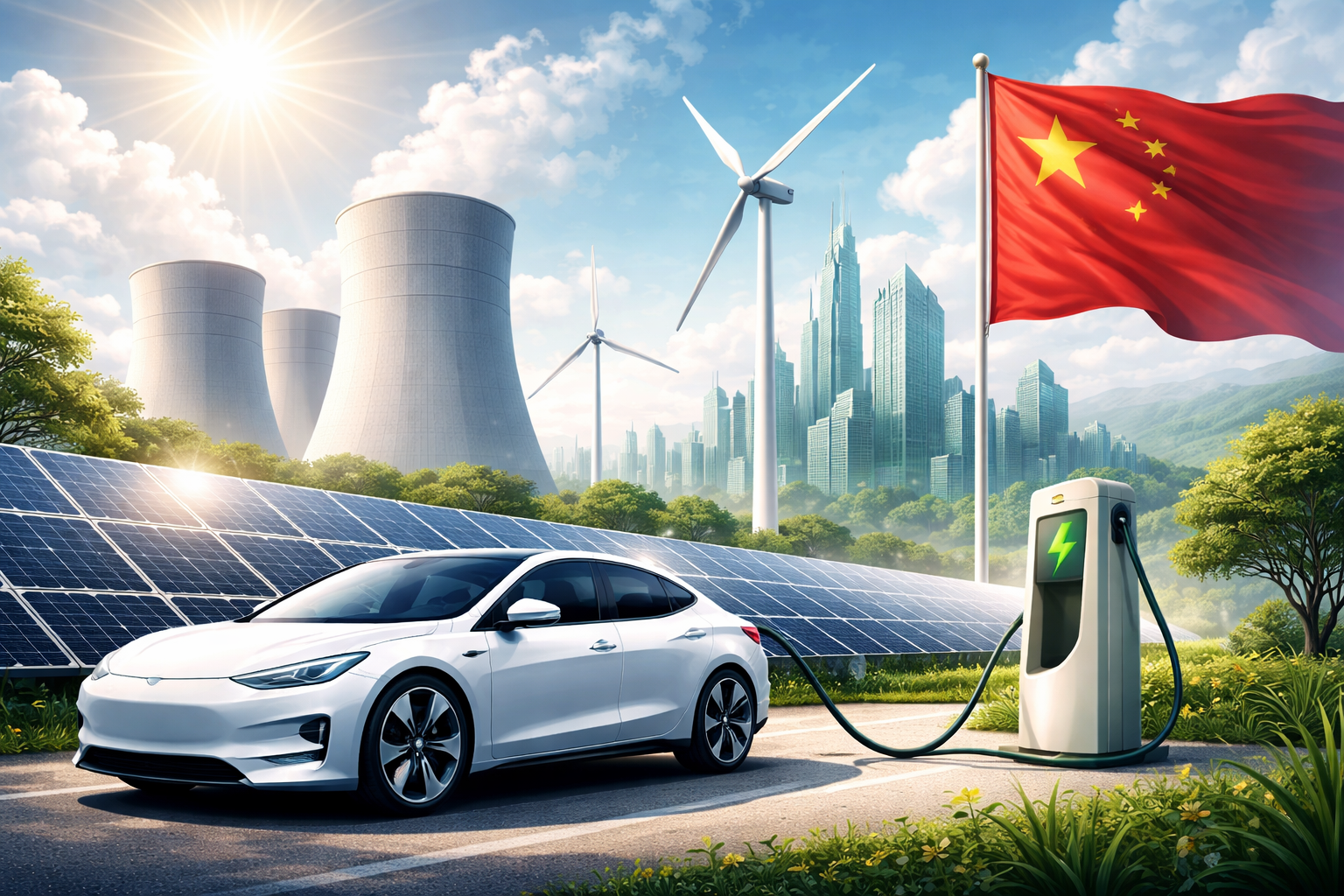
As 2026 unfolds, 2026 climate trends point to transformative shifts in global energy landscapes. Electric vehicles (EVs) dominate roads worldwide, nuclear power stages a bold comeback, and China accelerates its green energy shift 2026 ambitions. These developments promise reduced emissions, innovative tech, and massive investments, reshaping how nations combat climate change.
Driven by battery advancements and policy incentives, EV market growth 2026 accelerates beyond previous forecasts. Governments worldwide target net-zero goals, funneling billions into charging networks and supply chains. Meanwhile, nuclear power revival addresses intermittency issues plaguing renewables, with small modular reactors (SMRs) leading deployment. China’s dual role as top emitter and green innovator underscores the year’s pivotal dynamics.
EV Market Growth 2026: Charging Toward Dominance
EV market growth 2026 surges past 40% year-over-year, propelled by affordable models and expanded infrastructure. Solid-state batteries cut charging times to under 10 minutes, boosting consumer adoption. Europe mandates 100% zero-emission car sales by 2035, while the US offers $7,500 tax credits extended into 2026.
Global EV adoption forecasts predict 25 million units sold annually by year-end, capturing 35% market share. Tesla’s Cybertruck variants and BYD’s budget EVs flood emerging markets like India and Southeast Asia. Supply chain stabilization lithium from Australia, cobalt recycling in Europe eases price volatility. Automakers pivot entirely, with Ford and Volkswagen phasing out ICE engines by mid-decade.
China leads with 60% of global EV production, exporting to 100+ countries. Subsidies and urban bans on fossil-fuel vehicles propel domestic sales to 12 million units. This EV market growth 2026 not only slashes transport emissions responsible for 25% of global CO2 but spurs job creation in battery gigafactories.
Nuclear Power Revival: Reliable Clean Energy Returns
The nuclear power revival redefines baseload power in 2026. Facing solar and wind variability, policymakers embrace advanced reactors for 24/7 carbon-free electricity. SMRs, factory-built for rapid deployment, power data centers and industrial hubs.
Over 20 countries greenlight new plants, with the US approving 10 GW under the ADVANCE Act. NuScale’s VOYGR modules go online in Ohio, delivering 77 MW per unit at half construction time. France extends reactor lifespans to 60 years, while the UK builds Hinkley Point C ahead of schedule.
Nuclear fusion breakthroughs 2026 tantalize with net-energy milestones. Commonwealth Fusion Systems achieves Q>10 plasma confinement, drawing $2 billion investments. Though commercial fusion lags to 2030s, these advances validate fission’s interim role. Nuclear power revival counters anti-nuclear stigma, with public support hitting 65% in polls amid energy crises.
China’s Green Energy Shift 2026: From Coal to Clean
China’s China green energy shift 2026 marks the era’s boldest pivot. As the world’s factory, it installs 300 GW solar and wind capacity yearly, overtaking coal-fired generation. President Xi pledges carbon neutral goals China by 2060, with 2026 as a checkpoint: emissions peak confirmed, renewables at 50% grid share.
Ultrahigh-voltage lines transmit Gobi Desert solar to Shanghai, cutting losses to 3%. CATL dominates batteries, powering 70% global EVs. Hydrogen pilots fuel trucks on Beijing expressways, targeting 20% heavy transport by 2030.
Beijing’s dual-carbon strategy accelerates renewable energy transitions, retiring 100 GW coal plants while building equivalent clean capacity. Exports of PV modules flood markets, undercutting Western rivals by 30%. This shift not only curbs China’s 30% global emissions share but stabilizes supply chains for worldwide green tech.
Climate Tech Investments 2026: Fueling the Future
Climate tech investments 2026 shatter records at $500 billion, dwarfing 2025’s $400 billion. Venture capital floods carbon capture, green hydrogen, and AI-optimized grids. Breakthroughs in perovskite solar cells hit 35% efficiency, halving costs.
Direct air capture scales via Climeworks’ Mammoth plant in Iceland, sequestering 36,000 tons CO2 yearly. Climate tech investments 2026 prioritize adaptation: sea walls in Miami, drought-resistant crops in Africa. Public-private partnerships, like EU’s Horizon Europe, allocate €100 billion.
Interconnected Impacts and Challenges Ahead
These 2026 climate trends intertwine: Chinese EVs power nuclear grids, fusion R&D attracts global funds. Yet challenges persist mineral shortages, grid upgrades, policy reversals. Success hinges on international cooperation, with COP31 eyeing binding EV quotas.
Renewable energy transitions demand skilled labor; nuclear training programs expand globally. Global EV adoption forecasts hinge on recycling mandates, preventing e-waste mountains.
In summary, 2026 climate trends herald optimism amid urgency. EVs electrify mobility, nuclear ensures stability, and China’s green shift inspires scale. Bold investments and tech propel humanity toward Paris Agreement targets, proving decisive action bends the emissions curve.