|
Getting your Trinity Audio player ready... |
Federal Climate Strategy Enters a निर्णायक Phase
In 2026, climate policy in the United States has moved from long-term commitments to measurable implementation. Federal authorities are no longer focused only on setting emission targets; the emphasis has shifted toward execution, compliance, and economic impact. Climate initiatives now intersect directly with energy pricing, industrial competitiveness, and employment trends, making environmental policy a central pillar of national economic planning.
The administration continues to frame climate action as both a risk-management strategy and an industrial opportunity. However, rising costs and uneven regional adoption are intensifying political and economic debate.
Emissions Targets and Regulatory Enforcement
Federal agencies in 2026 are enforcing stricter emissions standards across power generation, transportation, and heavy industry. The Environmental Protection Agency has expanded reporting requirements for large emitters, particularly in oil refining, manufacturing, and utilities.
Carbon reduction targets align with international commitments, but enforcement mechanisms have grown more concrete. Compliance audits, emissions disclosures, and penalty frameworks are now operational rather than aspirational. Companies failing to meet benchmarks face financial consequences, increasing pressure on legacy energy producers.
At the same time, regulatory clarity has reduced uncertainty for investors. Markets now price climate compliance as a standard operational cost rather than a speculative risk.
Renewable Energy Expansion Accelerates
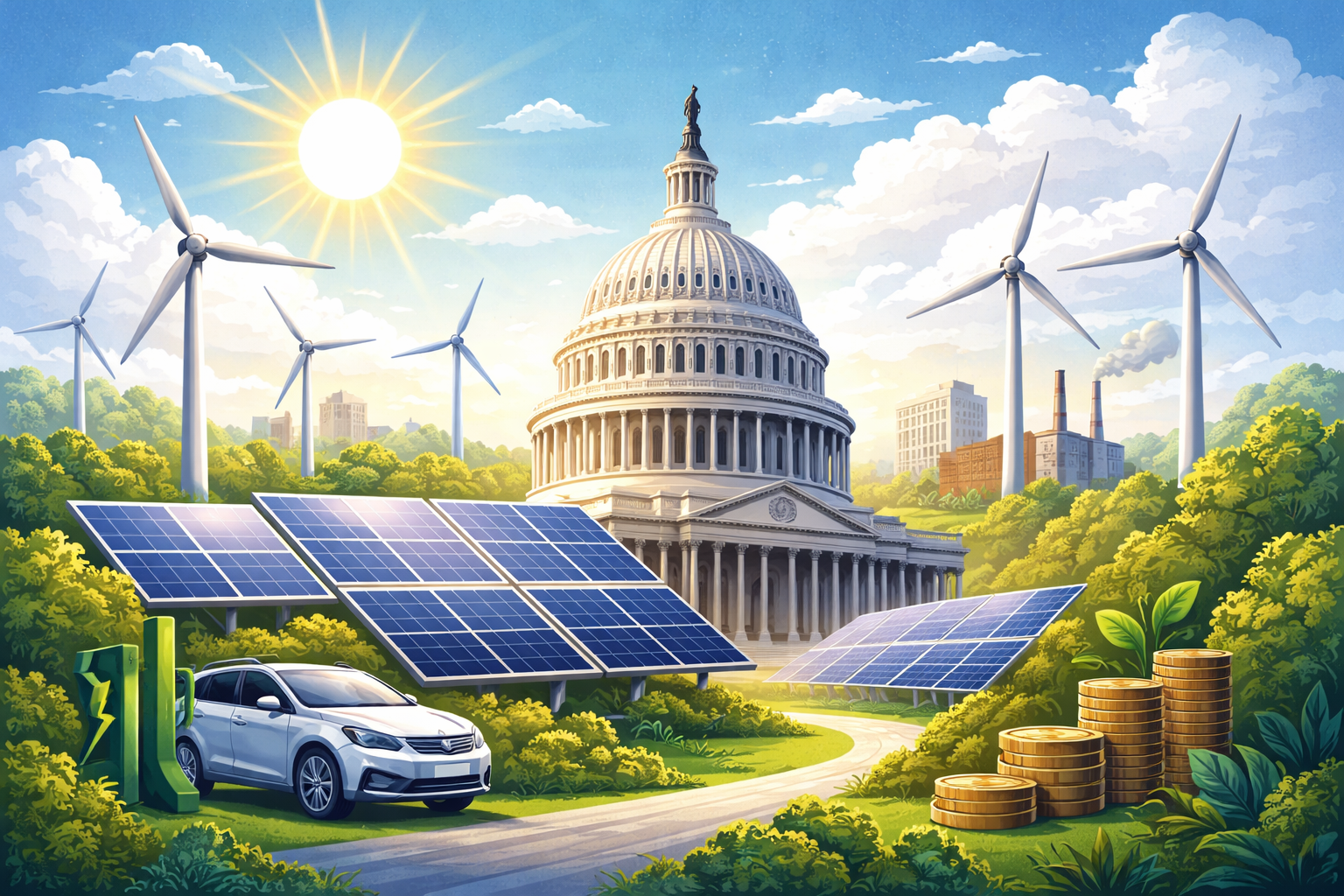
Renewable energy deployment remains the cornerstone of US climate policy in 2026. Federal incentives continue to support solar, wind, and battery storage projects, particularly in regions transitioning away from fossil fuel dependence.
Utility-scale solar installations have expanded across the Southwest and Midwest, while offshore wind projects gain momentum along the East Coast. Grid modernization funding aims to address reliability concerns as renewable penetration increases.
Despite progress, infrastructure bottlenecks persist. Transmission capacity limitations and permitting delays slow project timelines, highlighting the gap between policy intent and physical execution.
Energy Transition and Consumer Costs
One of the most visible impacts of climate policy in 2026 is on energy pricing. While renewable generation costs have declined, transition expenses related to grid upgrades, storage systems, and regulatory compliance continue to affect utility bills.
Consumers experience mixed outcomes. In regions with mature renewable infrastructure, energy prices show relative stability. In transition-heavy states, costs rise due to capital investment recovery and regulatory pass-throughs.
Energy affordability has become a critical political issue, forcing policymakers to balance long-term climate goals with short-term cost pressures on households and small businesses.
Industrial Policy and Job Market Effects
Climate policy increasingly functions as industrial policy. Federal funding supports domestic manufacturing of clean energy components, including batteries, electric vehicles, and grid hardware. The objective is to reduce supply chain dependence while creating high-skill jobs.
Employment growth is evident in renewable energy construction, engineering, and maintenance roles. However, job displacement remains a concern in fossil fuel-dependent regions. Retraining programs and transition assistance aim to mitigate workforce disruption, though effectiveness varies by state.
The labor market impact underscores that climate policy is not only environmental; it is structural economic reform.
State-Level Divergence Shapes National Outcomes
While federal direction is clear, state-level implementation differs significantly. Some states aggressively adopt clean energy mandates, electric vehicle incentives, and emissions caps. Others resist or slow adoption due to economic structure or political alignment.
This divergence creates uneven progress across the country. Businesses operating nationally face a fragmented regulatory landscape, increasing compliance complexity. At the same time, state experimentation provides data on policy effectiveness and cost control.
Federal authorities increasingly rely on incentives rather than mandates to encourage alignment.
Corporate Adaptation and Market Response
Corporate response to US climate policy in 2026 reflects strategic adaptation rather than resistance. Large firms integrate emissions targets into financial planning, supply chain management, and investor communications.
Climate risk disclosures now influence credit ratings and equity valuations. Companies demonstrating credible transition plans gain access to lower-cost capital, while laggards face investor scrutiny.
Smaller businesses, however, encounter higher compliance burdens relative to scale, prompting calls for regulatory flexibility and technical assistance.
Political Debate Intensifies Ahead of Elections
As climate policy reshapes energy markets and consumer costs, political scrutiny intensifies. Supporters argue that long-term economic resilience depends on decisive climate action. Critics emphasize rising costs, regulatory overreach, and uneven regional impacts.
Climate legislation and funding allocations have become prominent issues in congressional debates, particularly in energy-producing states. Public opinion remains divided, often correlating with local economic exposure rather than ideological alignment.
The durability of climate policy depends increasingly on its ability to deliver economic benefits alongside environmental outcomes.
Outlook for US Climate Policy Beyond 2026
By 2026, US climate policy has moved beyond symbolism into structural transformation. The direction is clear; emissions reduction, renewable expansion, and industrial transition define federal priorities. The challenge lies in execution efficiency, cost containment, and political sustainability.
How successfully policymakers manage energy affordability, workforce transition, and regional disparities will determine whether climate strategy strengthens long-term economic stability or becomes a source of prolonged friction.
Climate policy is no longer a peripheral issue in the United States; it is a defining force shaping the nation’s economic and political trajectory.