Historic Division: America Faces Unprecedented Political Fracture
Can a nation this divided find common ground, or are we witnessing the unraveling of American democracy as we know it?
The United States stands at a critical crossroads in 2025, grappling with levels of political polarization that historians compare to the nation’s most turbulent periods. Recent data reveals a startling reality: American political division has reached heights not seen since the Reconstruction Era following the Civil War, potentially exceeding even the ideological tensions of the Cold War period.
The Numbers Tell a Troubling Story
Current polarization stands at unprecedented levels in modern history, creating barriers to collaboration and understanding between Democrats and Republicans. According to research from multiple institutions, the percentage of Americans identifying as moderate dropped to a historic low of 34% in 2024, while extreme positions on both ends of the spectrum have solidified.
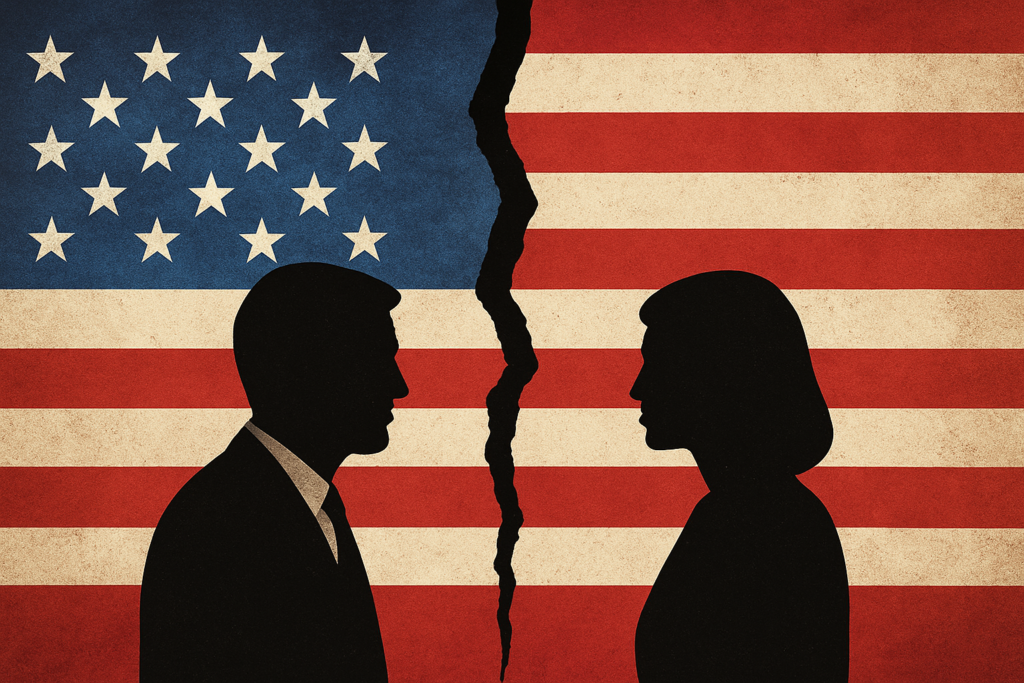
Among Republicans, 77% now identify as conservative, while 55% of Democrats identify as liberal. This ideological sorting represents a fundamental shift from the politically diverse parties of the 1950s and 1960s, when cross-party collaboration was commonplace and ideological overlap was substantial.
The Wall Street Journal’s recent assessment describes the current American political system as experiencing a total breakdown in trust between parties and among the general public, signaling deep structural problems in democratic governance.
Beyond Policy: The Rise of Emotional Polarization
What makes today’s political divide particularly dangerous is not just disagreement on policy issues, but what researchers call affective polarization an emotional hostility toward opposing party members. Pew Research polling from 2022 showed that 72% of Republicans and 63% of Democrats viewed the opposing party as more immoral than other Americans, dramatically increasing from 47% and 35% in 2016.
This emotional divide manifests in everyday life. Research indicates that 50% of Republicans and 35% of Democrats now prefer surrounding themselves with friends who share their political views. The partisan divide has transcended politics, affecting personal relationships, workplace dynamics, and even family gatherings.
How Did We Get Here? Comparing Cold War and Contemporary Divisions
The Cold War era, from 1945 to 1991, is often remembered for its ideological rigidity and us-versus-them mentality. However, scholars note a crucial difference: during that period, Americans were largely united against an external threat. The common enemy of Soviet communism created domestic cohesion despite political differences.
After the Cold War ended in 1991 and that common threat disappeared, polarization in Congress increased sharply. Without a unifying external challenge, internal divisions have intensified. Today’s polarization is characterized by Americans viewing fellow citizens not foreign adversaries as threats to their way of life.
Research using congressional voting patterns reveals Congress is now more ideologically divided than at any point in the last 125 years. The overlap interval between parties the number of moderate members who share ideological space is now zero, compared to approximately 50% overlap in the 1960s.
The Perfect Storm: Multiple Factors Driving Division
Several interconnected forces fuel America’s current polarization crisis. The diploma divide has emerged as a significant factor, with educational attainment increasingly predicting political affiliation. College-educated voters have increasingly aligned with the Democratic Party, while skepticism toward experts has grown among Republican voters and leaders.
Social media platforms, initially celebrated as bridges connecting people, have evolved into arenas amplifying political competition and reinforcing existing beliefs. Eight out of ten Americans now believe Republican and Democratic voters cannot agree on basic facts, let alone policies.
Economic inequality, cultural shifts, and debates over immigration and national identity have created what some scholars describe as an existential clash over American identity itself. These aren’t merely policy disagreements they represent fundamental disputes about the nation’s character and future direction.
The Human Cost of Division
The psychological toll of sustained political polarization cannot be overstated. Surveys reveal that 65% of Americans feel exhausted when thinking about politics, while only 10% feel hopeful. This widespread political fatigue suggests a population struggling to maintain civic engagement amid relentless partisan conflict.
Despite these challenges, local communities show greater resilience than state or federal institutions, with 83% of local government leaders believing polarization negatively affects the country, but only 31% seeing significant negative effects in their own communities. This suggests that grassroots efforts and face-to-face interactions may offer pathways through the current crisis.
Looking Forward: Can America Bridge the Divide?
The question facing Americans isn’t whether polarization exists the evidence is overwhelming but whether it can be reversed before causing irreparable damage to democratic institutions. Some political scientists suggest electoral reforms, increased civic education, and renewed emphasis on local governance could help reduce partisan tensions.
Others argue that until Americans rediscover shared values and common purposes, the nation will continue drifting toward greater fragmentation. The absence of unifying challenges comparable to World War II or the Cold War leaves America searching for new sources of national cohesion in an increasingly fractured political landscape.
As 2025 unfolds, the United States faces a defining moment: will it find ways to bridge ideological chasms and restore functional governance, or will polarization deepen further, threatening the foundations of American democracy? The answer may determine not just the nation’s political future, but its ability to address pressing challenges requiring unified action.